


What Every Hamilton Homeowner Should Know About On-Demand Hot Water
How does a tankless water heater work is a question more Hamilton homeowners are asking as energy bills climb and aging tank units start to fail. The short answer: instead of storing and continuously reheating a large tank of water, a tankless unit heats water only when you turn on a tap — and stops the moment you turn it off. No standby energy loss. No running out of hot water mid-shower.
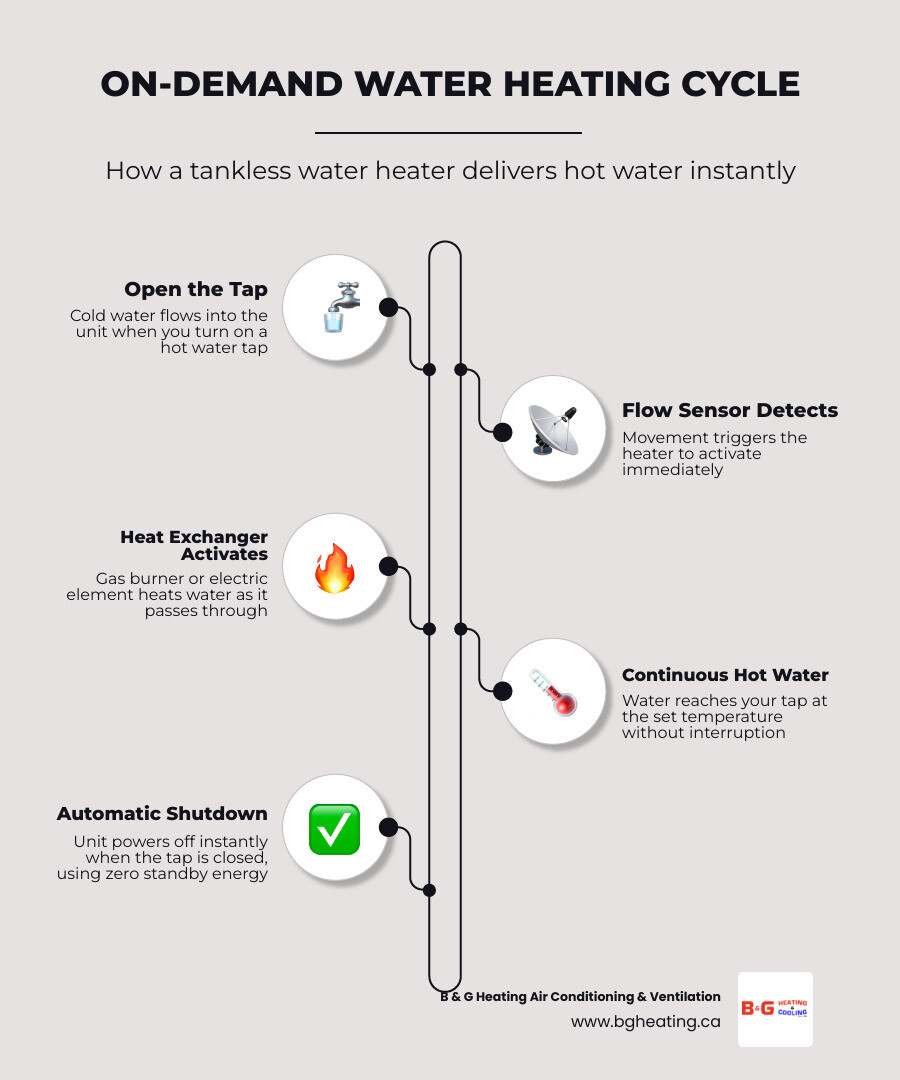
Here is a quick breakdown of the on-demand heating process:
- You open a hot water tap — cold water begins flowing into the unit
- A flow sensor detects the movement — and signals the heater to activate
- A gas burner or electric element fires up — and heats the water as it passes through the heat exchanger
- Hot water reaches your tap — at your set temperature, continuously
- You close the tap — the unit shuts off automatically, using zero standby energy
This on-demand approach is why tankless water heaters can be 24% to 34% more energy efficient than conventional storage tank heaters for homes using 41 gallons or less of hot water per day, according to the U.S. Department of Energy. For Hamilton homes dealing with cold winters and hard water, understanding exactly how this technology works — and whether it fits your household — can make a real difference in comfort and long-term energy costs.
How Does a Tankless Water Heater Work?
To understand how a tankless water heater works, it helps to look inside the cabinet. Unlike a traditional tank that relies on a massive volume of standing water kept hot 24/7, a tankless system is a compact, highly engineered heat-exchange machine. It sits quietly on your wall until a demand is made, operating like a high-efficiency highway on-ramp sensor that triggers immediate action only when traffic (water flow) is detected.

Inside the unit, several key components work in perfect harmony:
- The Flow Sensor: This is the gatekeeper of the system. When you turn on a hot water tap anywhere in your home, water begins moving through the plumbing. The flow sensor detects this movement instantly and sends a signal to the electronic control board to initiate the heating cycle.
- The Heat Exchanger: This is where the magic happens. A heat exchanger is a network of tightly coiled pipes (typically made of high-grade copper or stainless steel due to their exceptional thermal conductivity) surrounded by a heating source. As cold water travels through these coils, heat is rapidly transferred from the burner or element through the metal and into the water.
- The Control Board & Temperature Sensors: Modern tankless systems use advanced modulating controls. Temperature sensors at both the water inlet and outlet measure the temperature of the incoming cold water and outgoing hot water. The control board uses this data to adjust the gas flame or electrical output precisely, ensuring the water leaving the unit matches your exact thermostat setting (usually around 120°F or 49°C) within a fraction of a degree.
By heating water only when it is actively moving, the system eliminates standby energy loss entirely. This is one of the primary reasons we encourage homeowners to explore their options when Choosing the Right Water Heater for their properties in Hamilton, Ancaster, or Burlington.
Step-by-Step: How Does a Tankless Water Heater Work?
Let’s trace the exact path water takes from the moment you turn on a faucet to the second you turn it off:
- Flow Detection: You turn on the shower. Cold water from your local municipal supply enters the bottom of the tankless unit. The internal flow sensor registers this movement. Most units require a minimum flow rate of about 0.5 gallons per minute (GPM) to activate.
- Burner or Element Ignition: The control board receives the signal from the flow sensor. If it’s a gas unit, the fan turns on, the gas valve opens, and an electronic ignition device sparks the burner to life. If it’s an electric unit, the control board sends high-voltage electricity to the heating elements.
- The Heat Transfer Process: As the cold groundwater (which can be quite chilly in Southern Ontario) winds through the heat exchanger, the intense heat from the gas burner or electric elements warms the outer walls of the coils. The heat transfers rapidly to the water inside.
- Continuous Modulated Flow: The temperature sensors monitor the outgoing water. If you turn on a second faucet, the flow rate increases. The control board instantly detects this and modulates the gas valve to increase the flame height (or engages additional electric elements) to maintain a steady temperature.
- Automatic Shutdown: When you turn off the shower, the flow sensor detects that the water has stopped moving. The control board immediately cuts the gas supply or electrical current. The burners extinguish, the fan runs for a brief moment to clear any residual exhaust, and the system goes back into standby mode, consuming virtually zero energy.
Gas vs. Electric: How Does a Tankless Water Heater Work?
While both gas and electric tankless water heaters operate on the same fundamental principle of on-demand heating, they use entirely different energy sources and internal mechanics to achieve it.
Gas Tankless Water Heaters
Gas-fired models are the powerhouse systems of the tankless world. They utilize either natural gas or liquid propane to fire a burner array beneath the heat exchanger. These units are rated in BTUs (British Thermal Units), with residential whole-home gas models typically ranging from 120,000 to 200,000 BTUs.
Because gas burners can generate an immense amount of heat instantly, gas tankless water heaters deliver significantly higher flow rates than electric models — typically providing 5 to 11 gallons of hot water per minute. This makes them ideal for larger homes in the Hamilton area where multiple fixtures might run at the same time.
Additionally, modern gas models use electronic ignition devices rather than old-fashioned standing pilot lights. This avoids the energy waste and safety concerns common with older systems. If you have ever dealt with Water Heater Pilot Light Problems on an older tank model, you will appreciate the reliability of modern electronic ignition.
Electric Tankless Water Heaters
Electric models use heavy-duty electrical resistance coils submerged directly in the water path or wrapped tightly around the heat exchanger. Instead of gas valves, they use staged heating elements that turn on or off depending on the hot water demand.
While electric models are highly efficient and require no venting, they have lower heating capacities compared to gas. A whole-home electric tankless unit typically draws between 15,000 and 36,000 watts of power. Because of this massive electrical draw, they require specialized high-voltage electrical circuits (often requiring 240-volt connections and multiple 40-amp or 50-amp breakers).
In colder climates like Southern Ontario, where winter groundwater can drop to near-freezing temperatures, electric units often struggle to provide enough flow for an entire household simultaneously. They are, however, excellent options for point-of-use applications, such as a single sink, a remote pool house, or a small guest suite.
Condensing vs. Non-Condensing Tankless Water Heaters
If you decide to install a gas tankless water heater in your home, you will need to choose between two distinct technological categories: condensing and non-condensing. The difference lies in how they handle waste heat and combustion exhaust, which directly impacts their overall energy efficiency and installation requirements.
| Feature | Non-Condensing Tankless | Condensing Tankless |
|---|---|---|
| Heat Exchangers | Single (Primary only) | Dual (Primary & Secondary) |
| Energy Efficiency | ~80% to 85% | 90% to 98% (ENERGY STAR certified) |
| Exhaust Temperature | Very hot (approx. 199°C to 210°C) | Cool (approx. 53°C to 68°C) |
| Venting Material | Specialized Category III Stainless Steel | Inexpensive PVC or CPVC |
| Condensate Drain | Not required | Required (to drain acidic water) |
| Upfront Equipment Cost | Lower | Higher |
Non-Condensing Tankless Water Heaters
A non-condensing tankless water heater utilizes a single heat exchanger to warm the water. Because the combustion gases escape the unit quickly, the exhaust remains extremely hot — often reaching temperatures up to 210°C.
To handle this extreme heat safely, non-condensing units must be vented using specialized, corrosion-resistant Category III stainless steel pipes. These vents can be expensive to install and must be routed carefully through your home’s exterior walls. While non-condensing units are highly reliable, they typically capture only about 80% to 85% of the heat energy generated by the gas burner, with the rest escaping out the flue.
Condensing Tankless Water Heaters
Condensing models represent the pinnacle of modern water heating efficiency. These units feature a secondary heat exchanger positioned right in the path of the exhaust gases.
Before the hot combustion gases can escape out the vent, the incoming cold water passes through this secondary heat exchanger first. This preheats the water using “free” energy from the exhaust before it even reaches the primary burner-heated exchanger.
This process cools the exhaust gases dramatically — down to about 53°C to 68°C. Because the exhaust is so cool, the water vapor in the gas condenses into liquid water inside the unit (hence the name “condensing”). This low exhaust temperature allows installers to use inexpensive, lightweight PVC or CPVC piping for venting instead of stainless steel.
However, because the condensation process produces mildly acidic water, a condensing unit requires a dedicated condensate drain line routed to a nearby floor drain or laundry tub.
Because they recycle their own exhaust heat, ENERGY STAR certified condensing models use about 9% less energy than conventional gas tankless models, boasting efficiency ratings up to 98%. When comparing systems, our Tankless vs Tank Water Heater Ontario Homeowners Guide can help you weigh these efficiency benefits against your household’s daily hot water needs.
Sizing and Installation Requirements for Hamilton Homes
Sizing a tankless water heater is entirely different from sizing a traditional tank. With a tank, you simply choose a volume (such as 40, 50, or 60 gallons) that matches your family size. With a tankless system, you must size the unit based on two critical variables: flow rate and temperature rise.
Sizing Factor 1: Flow Rate (Gallons Per Minute)
First, you need to calculate your household’s peak hot water demand. This is the maximum amount of hot water you might reasonably expect to use at the exact same moment. To do this, add up the flow rates of all the fixtures you might run simultaneously:
- Low-flow showerhead: 1.5 to 2.0 GPM
- Standard showerhead: 2.5 GPM
- Kitchen faucet: 1.5 to 2.2 GPM
- Bathroom faucet: 0.5 to 1.5 GPM
- Washing machine: 2.0 GPM
- Dishwasher: 1.5 GPM
If you want to be able to run two standard showers (5.0 GPM total) and the dishwasher (1.5 GPM) at the same time, your tankless unit must be capable of delivering at least 6.5 GPM.
Sizing Factor 2: Temperature Rise
Temperature rise is the difference between the temperature of the incoming cold groundwater and your desired hot water output (typically 120°F / 49°C).
This is where geography plays a massive role. In Southern Ontario, our winter groundwater temperatures can drop to a chilly 40°F (4°C). To heat that water to 120°F, your tankless unit must achieve an 80-degree temperature rise.
Because heating water by 80 degrees requires significantly more energy than heating it by 40 degrees in a warmer southern climate, a tankless unit’s maximum flow rate drops during our cold Canadian winters. A unit rated for 9 GPM in Florida might only deliver 4.5 or 5 GPM in Hamilton during January. This is why we always size systems based on worst-case winter conditions to guarantee you never get caught in a freezing shower.
Typical Installation Requirements and Upgrades
Upgrading from a traditional storage tank to a tankless system is not a simple “plug-and-play” swap. There are several critical infrastructure requirements that must be handled by a licensed professional:
- Gas Line Upgrades: Standard tank water heaters typically use around 36,000 to 40,000 BTUs of gas. A whole-home tankless unit requires anywhere from 150,000 to 199,000 BTUs to heat water instantly. To supply this massive amount of fuel, your home’s gas line often needs to be upgraded from a standard 1/2-inch pipe to a larger 3/4-inch line, and your gas meter may need to be upsized by your utility provider.
- Venting Upgrades: Tankless units cannot share the same simple atmospheric chimney vent used by older tank heaters or mid-efficiency furnaces. They require dedicated, sealed-combustion venting systems that draw fresh air from outside and vent exhaust directly through an exterior wall.
- Electrical Connections: Gas tankless units still require electricity to power the control board, flow sensors, and internal exhaust fans. You will need a standard 120-volt outlet near the installation site. Electric models, as mentioned, will require extensive panel upgrades and dedicated high-voltage wiring.
- Condensate Management: If you choose a high-efficiency condensing model, a drain line must be installed to safely route the acidic condensation away from your basement floor.
Given these complex technical and safety requirements, securing a Professional Water Heater Installation is essential to ensure your new system complies with Ontario building codes and operates at peak efficiency.
Benefits and Limitations of Going Tankless
Like any major home appliance, tankless water heaters come with a unique set of advantages and challenges. Understanding both sides of the coin will help you decide if on-demand heating is the right fit for your home and lifestyle.
The Benefits
- Endless Hot Water: Since the unit heats water continuously as it flows, you will never “run out” of hot water. You can take a two-hour shower, wash three loads of laundry, and fill a giant soaking tub back-to-back without the water ever turning cold.
- Massive Space Savings: A traditional 50-gallon tank takes up a significant amount of valuable floor space in your basement or utility closet. A tankless water heater is about the size of a carry-on suitcase and mounts directly to the wall, reclaiming square footage for storage or basement finishing.
- Lower Energy Bills: By eliminating standby heat loss, tankless units only consume fuel when you turn on a tap. This can reduce your water heating bills by up to 30%, saving the average family hundreds of dollars annually.
- Water Conservation: Many modern tankless units feature water-saving settings that can save up to 1,000 gallons of water per year by optimizing flow rates during startup.
- Reduced Risk of Water Damage: Traditional tanks are prone to rusting and eventually bursting, which can cause catastrophic flooding in your basement. Because a tankless system holds virtually no water, the risk of a major flood is nearly eliminated.
The Limitations
- High Upfront Investment: The initial cost of the unit itself, combined with the required gas line, venting, and electrical upgrades, makes a tankless installation more costly upfront than a simple tank replacement.
- Simultaneous Usage Limits: While a tankless unit provides endless hot water, it has a finite flow rate. If you exceed that capacity (e.g., running the shower, the washing machine, and the dishwasher all at once), the water temperature may drop or the system may struggle to distribute hot water evenly.
- The “Cold Water Sandwich” Effect: If you turn the hot water tap on, then off, and then immediately back on again, a small pocket of unheated water can get trapped in the pipes between the two draws. This can result in a brief, unexpected burst of cold water mid-use. Premium models with built-in recirculation pumps or “Hot Start” programming help eliminate this issue.
If your current water heater is showing its age, experiencing leaks, or struggling to keep up with your family’s needs, it may be the perfect time to Upgrade Your Aging Water Heater System to a modern, highly efficient on-demand unit.
Lifespan, Maintenance, and Long-Term Efficiency
One of the most compelling arguments for going tankless is durability. While a traditional storage tank water heater typically lasts between 10 and 15 years, a high-quality tankless water heater boasts a life expectancy of more than 20 years when properly cared for. Because these units are built with easily replaceable individual parts, their operational lifespan can often be extended even further.
However, achieving this impressive 20-year lifespan requires a commitment to regular preventative maintenance.
The Threat of Hard Water and Mineral Buildup
The primary enemy of any tankless water heater is mineral scale. In many parts of Southern Ontario — including Hamilton, Brantford, and surrounding areas — municipal groundwater is moderately to highly hard, containing elevated levels of calcium and magnesium.
As water is rapidly heated inside the narrow copper channels of the tankless heat exchanger, these minerals solidify and bake onto the interior walls of the pipes. Over time, this scale buildup acts as an insulating barrier, forcing the burner to run hotter and longer to heat the same amount of water. This dramatically reduces the unit’s energy efficiency and puts extreme thermal stress on the heat exchanger, eventually leading to premature system failure.
To protect your investment, we highly recommend reading our guide on Mineral Buildup 101 How It Destroys Water Heaters in Hard Water Areas to understand how hard water impacts your home’s plumbing systems.
The Essential Maintenance Schedule
To keep your system running safely and efficiently, you should follow this basic maintenance roadmap:
- Annual Descaling (Flushing): Once a year, the tankless unit should be isolated from your home’s plumbing and flushed with a specialized descaling solution (or food-grade white vinegar) using a small submersible pump kit. This process dissolves and removes the accumulated calcium and magnesium scale from inside the heat exchanger.
- Inlet Filter Cleaning: Tankless units feature a small screen filter at the cold water inlet designed to catch sediment and rust particles before they enter the system. This filter should be checked and rinsed out every few months.
- Venting Inspection: Ensure the outdoor vent terminations remain clear of debris, bird nests, ice, and snow accumulation during our harsh Ontario winters.
For a comprehensive look at how to protect your on-demand system, check out our guide on All About Tankless Water Heater Maintenance in Canada to ensure you keep your system running at peak performance year after year.
Frequently Asked Questions about Tankless Water Heaters
Can a tankless water heater run out of hot water?
No, a properly sized tankless water heater will never “run out” of hot water because it heats water continuously on demand. Unlike a traditional tank that must refill and reheat after its stored water is depleted, a tankless unit will keep delivering hot water for as long as the tap is open.
However, you can exceed its flow rate capacity. If you try to run multiple hot water fixtures simultaneously beyond the unit’s rated GPM, the water pressure or temperature may drop. Proper sizing prevents this issue entirely.
Do tankless water heaters work in cold Canadian winters?
Yes, they work exceptionally well, but winter climate conditions must be factored into the initial sizing of the unit. Because incoming groundwater temperatures in Southern Ontario can drop to 40°F (4°C) or lower during the winter, the heater must work much harder to raise the water to a comfortable 120°F (49°C).
This 80-degree temperature rise requires more heating power, which reduces the maximum GPM flow rate of the unit. We always size our local installations based on these winter conditions to ensure you have plenty of hot water even on the coldest January mornings. To learn more about how our local climate affects home appliances, read our article on Water Heater Lifespan in Southern Ontario 101.
How often does a tankless water heater need maintenance?
For most homes in the Hamilton area, a tankless water heater requires professional maintenance once a year. This annual service includes flushing the heat exchanger to remove mineral scale, cleaning the inlet water filter, and inspecting the burner assembly and venting system.
If your home has exceptionally hard water and you do not have a water softener installed, you may need to flush the system every six months to prevent damage. To schedule your next service, explore our professional Water Heater Tune Up Maintenance Hannon On options.
Conclusion
Understanding how does a tankless water heater work reveals why this innovative technology has become the preferred choice for modern, energy-conscious homeowners. By heating water only when you need it, these compact, wall-mounted systems eliminate standby energy waste, reclaim valuable basement floor space, and deliver a continuous, endless supply of hot water.
While the transition from a traditional tank requires careful sizing and some initial infrastructure upgrades, the long-term energy savings, superior durability, and 20+ year operational lifespan make it an incredibly smart investment for many households.
At B & G Heating Air Conditioning & Ventilation, we have spent decades helping families across Hamilton, Stoney Creek, Ancaster, Burlington, and surrounding areas find the perfect comfort solutions for their homes. As a trusted, family-owned HVAC company, our focus is always on quality workmanship, honest advice, and complete customer satisfaction.
Whether you are ready to upgrade to a high-efficiency condensing tankless system, need a professional maintenance flush, or simply want expert advice on your home’s water heating strategy, we are here to help.
Ready to experience the comfort and savings of on-demand hot water? Explore our comprehensive options on the B & G Heating Services and Products page, or contact our friendly local team today to schedule your in-home assessment!