


Is Once a Year Enough? What Canadian Homeowners Need to Know About AC Servicing
If you’ve ever wondered how often should you service your air conditioner in Canada, the short answer is clear: once a year, every year — ideally in early spring before the cooling season begins.
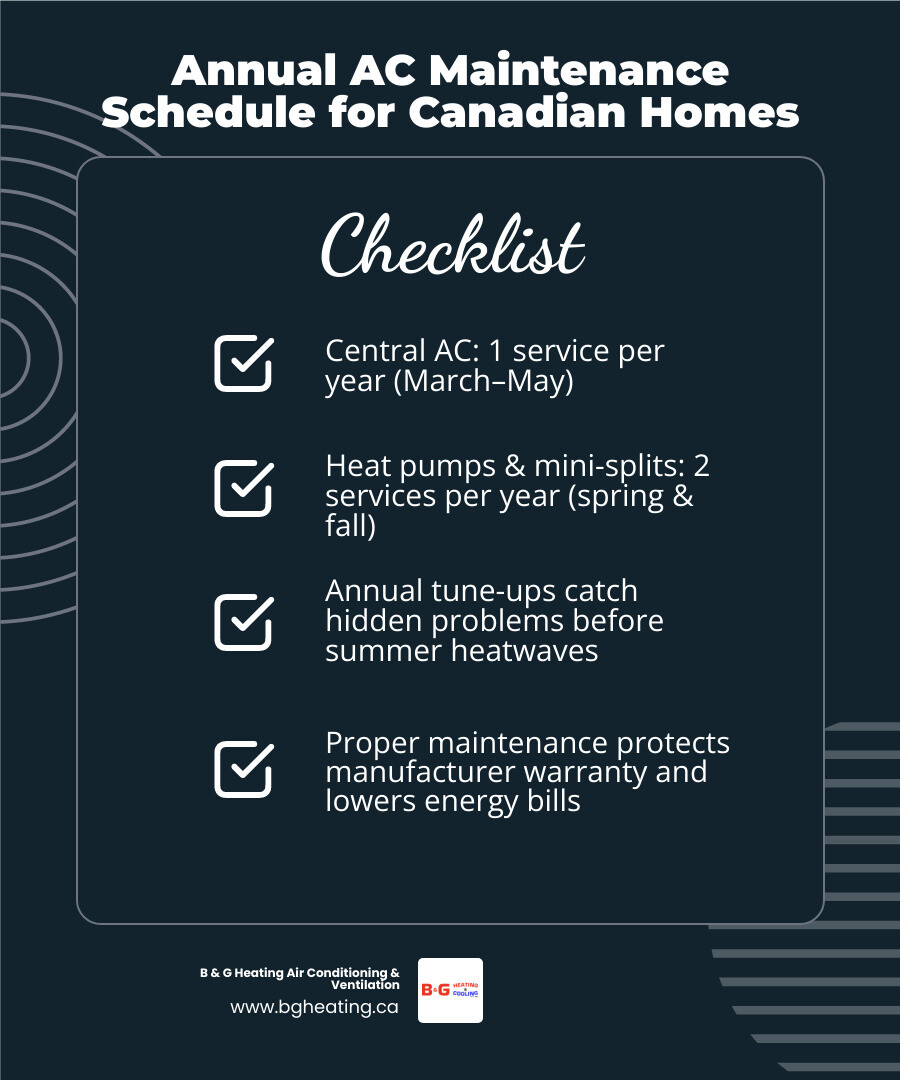
Quick Answer: AC Service Frequency in Canada
| System Type | Recommended Service Frequency | Best Time to Schedule |
|---|---|---|
| Central air conditioner | Once per year | Early spring (March-May) |
| Heat pump | Twice per year | Spring and fall |
| Ductless mini-split | Twice per year | Spring and fall |
About two-thirds of the energy used in the average Canadian home goes toward heating and cooling. That’s a big investment — and like any major investment, it needs regular care to perform well and last.
Most homeowners only think about their AC when something goes wrong. But by then, a small issue has often become an expensive repair. Annual professional maintenance helps catch problems early, keeps your system running efficiently, and can even be required to keep your manufacturer’s warranty valid.
For Hamilton homeowners dealing with hot, humid summers and cold winters, skipping that yearly tune-up is a risk that rarely pays off.
How Often Should You Service Your Air Conditioner in Canada?

To keep your cooling system operating at peak performance, you should have it professionally serviced once every 12 months. Understanding How Often Do I Need an AC Unit Tune-Up? is the first step toward avoiding unexpected mid-summer breakdowns. While it is easy to assume that a system that starts up on demand is in perfect health, minor mechanical wear and dust accumulation happen silently behind the scenes.
An annual professional check-up ensures that every electrical connection, mechanical component, and refrigerant line is inspected under controlled conditions. This 12-month interval is not just a friendly suggestion from HVAC professionals; it is also a standard requirement for major equipment manufacturers. If a critical component like your compressor fails while the system is under warranty, the manufacturer will often request documented proof of yearly professional maintenance before approving a replacement part.
To help you visualize how to care for your system throughout the year, here is a quick breakdown of what you can handle yourself versus what requires a licensed professional:
| Task Type | Maintenance Activity | Who Should Do It? | Frequency |
|---|---|---|---|
| DIY | Inspect and replace air filters | Homeowner | Every 1–3 months |
| DIY | Clear debris and trim plants around outdoor unit | Homeowner | Monthly during summer |
| DIY | Ensure indoor supply vents are unblocked | Homeowner | Ongoing |
| Professional | Electrical voltage and current testing | Licensed Technician | Once per year |
| Professional | Refrigerant pressure and leak testing | Licensed Technician | Once per year |
| Professional | Deep cleaning of evaporator and condenser coils | Licensed Technician | Once per year |
| Professional | Condensate drain line clearing and testing | Licensed Technician | Once per year |
Why Ontario’s Climate Demands Regular Care
Living in Southern Ontario—whether you are in Hamilton, Mississauga, Burlington, or Oakville—means experiencing some of the most dramatic seasonal weather swings in the country. We transition from freezing, snow-heavy winters to sweltering, incredibly humid summers.
This extreme climate places unique stress on your home comfort systems. During the winter, your outdoor condenser unit sits idle, exposed to freezing temperatures, ice, heavy snow, and falling debris. In the spring and summer, the high humidity levels in areas near Lake Ontario force your air conditioner to work twice as hard. An AC unit does not just cool your home; it acts as a dehumidifier. When humidity levels soar, your system must run longer cycles to pull moisture out of the air.
Without a dedicated AC Maintenance Tune-Up Hannon On to clean out winter debris and optimize the system for summer humidity, your air conditioner will struggle to keep up, leading to accelerated wear and tear.
Should You Service Your AC Even If It Seems to Work Fine?
The simple answer is yes. Many homeowners believe that if their air conditioner is blowing cool air, there is no reason to schedule a service visit. However, proactive preventative care is designed to find hidden issues before they turn into full-scale system failures.
There are 4 Key Reasons You Must Get Your Air Conditioner Serviced Once Every Year, even if it seems to be running perfectly:
- Undetected Refrigerant Leaks: A system can run with slightly low refrigerant levels, but it will consume significantly more energy and slowly damage the compressor.
- Electrical Wear: Capacitors and contactors degrade over time due to electrical stress. A technician can test these components and replace a failing capacitor before it leaves you without cooling on a hot weekend.
- Dust and Mold Build-Up: Dust naturally settles on the indoor evaporator coil over time. This restricts heat transfer, forcing the system to run longer cycles.
- Warranty Protection: As mentioned, skipping your annual service can void your manufacturer’s warranty, leaving you responsible for major repairs down the road.
How often should you service your air conditioner in Canada before summer heatwaves?
Timing is everything when it comes to HVAC maintenance. The absolute best time to schedule your service is in the early spring—specifically during March, April, or early May.
There is a highly practical reason Why is Early Spring Idea Time for AC Tune-Up?. When the first major summer heatwave hits Southern Ontario, local HVAC companies are flooded with emergency repair calls from homeowners whose systems failed under the sudden heat load. By booking your tune-up early in the spring, you ensure your system is fully prepared before the hot weather arrives. This proactive approach saves you from the discomfort of waiting for an emergency repair technician during a mid-July heatwave.
The Core Benefits of Regular AC Maintenance
Investing in regular preventative care is one of the smartest decisions you can make for your home. The long-term Benefits of Regular AC Maintenance far outweigh the temporary convenience of ignoring your system. When you schedule annual tune-ups, you are actively protecting your investment and ensuring your home remains a comfortable sanctuary all summer long.
There are clear, measurable Benefits of Preventive AC Maintenance that directly impact your wallet and your daily comfort. Let’s look closer at how regular care keeps your system running efficiently.
Maximizing Energy Efficiency and Reducing Utility Bills
Your air conditioner’s energy efficiency is directly tied to how clean and well-adjusted its components are. When dust, dirt, and pollen coat the outdoor condenser coil and the indoor evaporator coil, they act as an insulating blanket. This makes it incredibly difficult for the system to release heat outdoors and absorb cool air indoors.
There are 3 Reasons You Should Get AC Maintenance in the Spring that relate directly to your energy bills:
- Improved Airflow: Cleaning the blower components and coils ensures air flows freely through your ductwork, meaning the system doesn’t have to work overtime.
- Reduced Electricity Use: Regular professional maintenance can help your cooling system use up to 15% less electricity compared to a neglected unit.
- Shorter Running Cycles: When heat transfer is optimized, your home reaches its target temperature much faster, reducing the overall runtime of your system.
Extending the Lifespan of Your Cooling System
An air conditioner is a major mechanical system with many moving parts. Just like a car, regular oiling, cleaning, and adjustments prevent premature wear and tear. A well-maintained air conditioner has an average life expectancy of 15 to 17 years, with many units lasting up to 20 years.
Without regular maintenance, the system is forced to run longer, hotter cycles to cool your home. This extra strain falls heavily on the compressor—the “heart” of your air conditioner. If the compressor fails prematurely due to overworked conditions, it is often more practical to replace the entire outdoor unit. Keeping the coils clean, the electrical components strong, and the moving parts lubricated protects your compressor and helps your system reach its full potential lifespan.
What Does a Professional AC Tune-Up Include?
When you hire a professional team for an air conditioner service, you are getting a comprehensive, multi-point inspection. A thorough, professional tune-up is not a quick 10-minute check; it generally takes between 1 and 2 hours to complete properly.
Following a detailed Spring Air Conditioner Tune-Up Checklist ensures that no small detail is overlooked. A certified technician will inspect both your indoor and outdoor equipment to guarantee safe and efficient operation.
Electrical and Mechanical Component Checks
The electrical system of your air conditioner carries high voltage and must be handled with care. During a professional visit, a technician will perform several critical safety and performance checks:
- Thermostat Calibration: Verifying that your thermostat communicates accurately with your cooling system so you aren’t wasting energy.
- Electrical Connection Inspection: Tightening all electrical connections and measuring the voltage and current on the motors. Loose connections can cause electrical shorts or damage expensive control boards.
- Lubrication: Oiling all moving parts, including the blower motor and condenser fan, to eliminate friction and reduce wear.
- Controls Check: Testing the system’s start-up, cycle, and shut-down sequences to ensure all safety controls are operating exactly as intended.
Coil Cleaning and Refrigerant Level Verification
The coils and refrigerant are responsible for the physical transfer of heat out of your home. If either of these areas is compromised, your system’s cooling capacity drops instantly.
During a dedicated AC Service Hannon On, your technician will focus on these essential refrigeration components:
- Coil Inspection and Cleaning: Gently cleaning the dirt and debris off the outdoor condenser coil and checking the indoor evaporator coil.
- Refrigerant Pressure Testing: Verifying that the system has the exact amount of refrigerant specified by the manufacturer. In Canada, only licensed HVAC technicians with an Ozone Depletion Prevention (ODP) certificate can legally handle and adjust refrigerants.
- Condensate Drain Line Check: Inspecting and clearing the condensate drain line. As your AC removes humidity from the air, water collects in a drain pan and flows outside. If this line gets plugged with algae or dust, it can cause water damage inside your home or raise indoor humidity levels.
Essential DIY Maintenance Tasks for Homeowners
While complex electrical and refrigeration work must always be left to certified professionals, there are several highly effective maintenance tasks that you can—and should—perform yourself to keep your system running smoothly between professional visits.
Familiarizing yourself with Essential Spring AC Maintenance Tips will keep your system protected and help you maintain excellent indoor air quality throughout the summer months.
How often should you service your air conditioner in Canada with filter replacements?
The single most important DIY task is checking and replacing your HVAC air filter. Your air conditioner relies on your furnace’s blower fan and filter to circulate cool air through your home.
During the active cooling season, you should inspect your air filter every 30 days. For standard 1-inch pleated filters, plan to replace them every 30 to 60 days. If you have pets, allergies, or a dusty household, you may need to change them more frequently. Some homes use wider 4-inch media filters, which can last up to a full year, but they should still be checked periodically.
Replacing a dirty, clogged air filter with a fresh one is incredibly impactful:
- It can lower your air conditioner’s energy consumption by 5% to 15%.
- It prevents dust from bypassing the filter and settling on your indoor evaporator coil.
- It maintains healthy indoor air quality by trapping pollen, dust mites, and pet dander.
- It prevents the blower motor from overheating due to restricted airflow.
Keeping the Outdoor Condenser Unit Clear
Your outdoor condenser unit needs plenty of space to breathe. It works by pulling outdoor air through its metal fins to cool down the hot refrigerant inside. If airflow around this unit is restricted, the system will struggle to release heat.
To keep your outdoor unit clear:
- Maintain at least a two-foot clearance around the entire unit. Trim back any bushes, shrubs, tall grass, or flowers.
- Regularly check for and remove fallen leaves, twigs, cottonwood seeds, and grass clippings that have accumulated on the sides of the unit.
- Gently brush away any debris using a soft broom. Never use a high-pressure power washer on the condenser fins, as the intense water pressure can easily bend and damage the delicate aluminum fins, blocking airflow permanently.
Frequently Asked Questions About Canadian AC Maintenance
What happens if you skip annual AC maintenance?
Skipping your annual maintenance is a gamble that often leads to higher long-term costs. Over time, dust accumulates on the coils, electrical connections loosen, and moving parts lose their lubrication.
This causes a steady drop in operating efficiency, meaning your monthly utility bills will rise. It also increases the risk of a major system failure—such as a failed capacitor, a burnt-out blower motor, or a frozen evaporator coil—during the hottest weeks of the summer. Finally, neglecting regular servicing can void your manufacturer’s warranty, leaving you responsible for the full cost of any major repairs.
How long does a professional AC maintenance visit take?
A thorough, professional maintenance visit typically takes between 1 and 2 hours. During this time, the technician performs a complete diagnostic evaluation, cleans the outdoor coils, checks the electrical connections, tests system performance, and ensures the condensate drain is clear.
What are the signs that your air conditioner needs immediate professional service?
While annual maintenance helps prevent breakdowns, you should call for professional service immediately if you notice any of the following warning signs:
- Unusual Noises: Squealing, grinding, rattling, or loud banging sounds coming from either the indoor or outdoor unit.
- Weak or Warm Airflow: Air coming out of your vents feels lukewarm, or the airflow is significantly weaker than usual.
- Frequent Cycling: The system turns on and off rapidly every few minutes without cooling your home to the set temperature.
- Ice or Water Accumulation: Visible ice forming on the outdoor refrigerant lines or water pooling around your indoor furnace unit.
Conclusion
Your air conditioner is a vital part of keeping your home comfortable, healthy, and safe throughout the warm Canadian summer. By scheduling a professional tune-up once a year, you protect your system’s lifespan, keep your energy bills low, and gain valuable peace of mind.
At B & G Heating Air Conditioning & Ventilation, we have spent years helping homeowners across Hamilton and the surrounding areas stay comfortable in every season. Our experienced, family-owned team is dedicated to providing honest, high-quality maintenance that keeps your cooling system running perfectly.
Don’t wait for the summer heatwaves to test your system. Schedule your professional AC maintenance today and ensure your home stays cool and comfortable all season long!