


Does Hard Water from Lake Ontario Area Affect Tankless Water Heater Performance?
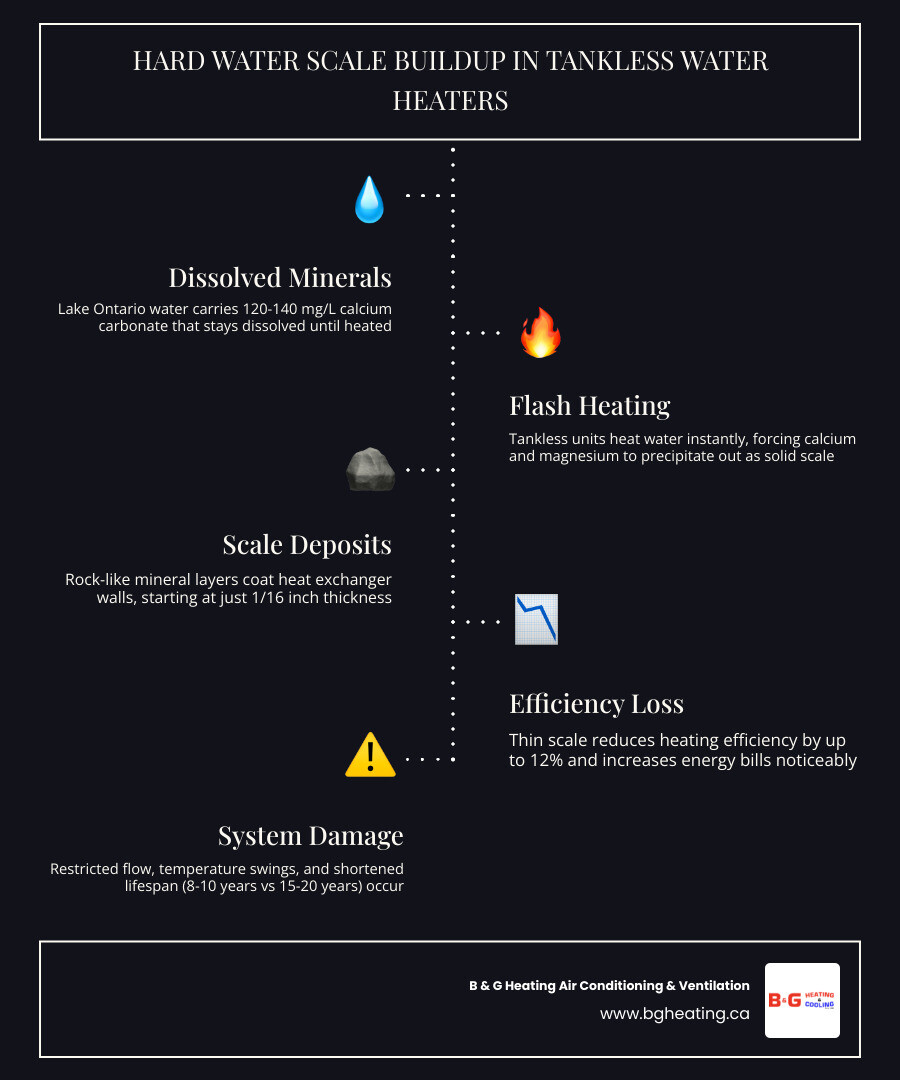
Does hard water from the Lake Ontario area affect tankless water heater performance? Yes — and more significantly than most homeowners realize. Water in the Hamilton and broader Lake Ontario region typically measures around 120 to 140 mg/L of calcium carbonate, placing it in the moderately hard range. While that may sound manageable, the way tankless water heaters work makes them especially vulnerable to the mineral buildup that hard water leaves behind.
Here is a quick summary of how Lake Ontario area hard water impacts tankless water heaters:
- Efficiency loss: Scale as thin as 1/16 of an inch can reduce heating efficiency by up to 12%
- Higher energy bills: Just 2 mm of scale can add measurably to your annual energy costs
- Reduced lifespan: Without regular maintenance, a tankless unit that should last 15 to 20 years may fail in 8 to 10 years
- Flow rate problems: Mineral deposits narrow the heat exchanger passages, reducing hot water pressure
- Temperature fluctuations: Scale-coated sensors and passages cause inconsistent water temperature
- Warranty risk: Most manufacturers exclude scale damage from warranty coverage without documented maintenance
Unlike traditional tank-style heaters, tankless units heat water on demand using intense, concentrated heat. This flash-heating process causes dissolved calcium and magnesium to precipitate out of the water almost instantly, forming hard, rock-like scale deposits directly on the heat exchanger walls. Over time, that buildup quietly chips away at performance — and most homeowners never notice until they are already dealing with rising energy bills, cold showers, or an unexpected repair.
If you live in Hamilton or the surrounding Lake Ontario region, this is not a distant concern. It is an active process happening inside your water heater right now.
Understanding Water Hardness in the Lake Ontario Region
To understand how water quality affects your home, we must first look at what water hardness actually is. Water hardness is determined by the concentration of dissolved minerals, primarily calcium carbonate ($CaCO_3$) and magnesium. These minerals are measured in either milligrams per litre (mg/L), parts per million (ppm), or grains per gallon (gpg).
According to water quality standards:
- Soft Water: Below 60 mg/L (less than 3.5 gpg)
- Moderately Hard Water: 60 to 120 mg/L (3.5 to 7.0 gpg)
- Hard Water: 120 to 180 mg/L (7.0 to 10.5 gpg)
- Very Hard Water: Over 180 mg/L (over 10.5 gpg)
The source of your municipal water plays a massive role in its mineral profile. Surface water sources, like Lake Ontario, tend to have consistent, moderate hardness. Municipalities that rely on groundwater (aquifers) or a blend of groundwater and river water often experience much higher mineral concentrations because the water has spent years filtering through underground limestone deposits.
In our Southern Ontario service areas, water hardness varies significantly:
| Location | Typical Sourcing | Hardness Level (mg/L) | Classification |
|---|---|---|---|
| Hamilton / Hannon / Stoney Creek | Lake Ontario (Surface) | 120 – 140 | Moderately Hard to Hard |
| Burlington / Oakville | Lake Ontario (Surface) | 120 – 130 | Moderately Hard |
| Guelph | Groundwater Wells | 300 – 400+ | Very Hard |
| Kitchener / Waterloo | Groundwater & Grand River | 300 – 500+ | Extremely Hard |
| Brantford | Grand River | 180 – 310 | Very Hard |
For homeowners comparing systems, our Tankless vs Tank Water Heater Ontario Homeowners Guide provides an excellent breakdown of how local conditions shape your equipment choices. While Lake Ontario’s water is more forgiving than the extreme groundwater found in Kitchener or Guelph, it still sits comfortably above the threshold where mineral scaling begins to occur. Over years of constant operation, even moderately hard water will take a toll, which directly impacts the overall Water Heater Lifespan in Southern Ontario 101.
Does Hard Water from Lake Ontario Area Affect Tankless Water Heater Performance?
Yes, it absolutely does. To understand why, we have to look at the internal components of a tankless system. Traditional tank heaters store dozens of gallons of water and heat it slowly. Tankless units, on the other hand, are engineered with compact, highly efficient copper or stainless steel heat exchangers. These heat exchangers feature incredibly narrow water passages designed to maximize contact with the burner’s heat.
When hard water enters these tight spaces, the dissolved calcium and magnesium react to the high temperatures. This heat forces the minerals to crystallize and precipitate out of solution, clinging to the metallic walls of the heat exchanger. This process is known as mineral scaling.
This mineral crust acts as an unwanted layer of thermal insulation. Because calcium scale is a terrible conductor of heat, the burner must run hotter and longer to transfer the same amount of heat to the water. This results in:
- Efficiency Loss: The system consumes more fuel to achieve the target temperature.
- Flow Rate Reduction: As the scale layer thickens, it physically narrows the water passages, restricting the volume of hot water that can pass through your fixtures.
- Pinhole Leaks and Metal Fatigue: The localized overheating of the heat exchanger metal causes thermal stress, eventually leading to cracks and leaks.
To learn more about this destructive cycle, read our detailed guide on Mineral Buildup 101: How It Destroys Water Heaters in Hard Water Areas. If you have noticed a steady decline in your home’s water pressure, you can also check out our tips for Troubleshooting Low Hot Water Pressure.
How Does Hard Water from Lake Ontario Area Affect Tankless Water Heater Performance Over Time?
The chemical reaction that causes scaling accelerates as water temperatures rise. When your tankless unit “flash-heats” cold water to your desired temperature, the sudden thermal jump causes immediate mineral precipitation.
In the first few months, a microscopic film of scale forms. By the end of year one in a typical Hamilton home, this film can grow into a measurable layer. Research from the Water Quality Association shows that a scale buildup of just 1/16 inch (approximately 1.5 mm) on a heat exchanger can reduce operating efficiency by up to 12%. If left unaddressed for several years, a 2 mm layer of scale can add significant waste to your annual energy bills.
Without regular maintenance in hard water regions, the typical 15 to 20-year lifespan of a high-quality tankless unit can easily be cut in half, dropping to just 8 to 10 years. If your current unit is struggling under the weight of years of neglected scale, it may be time to Upgrade Your Aging Water Heater System to restore comfort and efficiency to your home.
Troubleshooting: Does Hard Water from Lake Ontario Area Affect Tankless Water Heater Performance?
How do you know if minerals are currently clogging your system? Keep an eye out for these common warning signs:
- The “Cold Water Sandwich” Effect: If your shower fluctuates from hot to cold and back to hot, scale may be insulating the internal temperature sensors, preventing them from reading water temperature accurately.
- Kettling and Popping Noises: If you hear deep rumbling or popping sounds when the unit fires up, it is the sound of water trapped beneath scale deposits rapidly boiling into steam.
- Error Codes: Modern tankless units will display specific error codes (often related to combustion, venting, or flame failure, such as E030 or LC) when the heat exchanger overheats.
- Drop in Hot Water Pressure: If your cold water pressure is perfectly fine but your hot water has slowed to a trickle, scale has narrowed the heat exchanger passages.
If you recognize these symptoms, do not wait for the system to shut down completely. Consult our guide on Signs You Need Water Heater Repair or contact our local experts for prompt Water Heater Repair Hannon On to clear the scale before permanent damage occurs.
Comparing Gas vs. Electric Tankless Units in Hard Water
When choosing a tankless water heater, homeowners must decide between natural gas (or propane) and electric models. This choice becomes even more critical in regions with cold winters and hard water.
Gas tankless heaters utilize a burner to heat a copper or stainless steel heat exchanger. While scale certainly forms inside these units, the heat is distributed across a larger surface area. Additionally, gas units boast a much higher heating capacity, making them the preferred choice for handling Southern Ontario’s chilly winter groundwater temperatures.
Electric tankless units rely on high-powered electric heating elements immersed directly in the water flow. Because these elements must reach incredibly high temperatures to heat water instantly, they attract mineral scale like a magnet. This highly concentrated heat causes rapid, thick scale accumulation on the elements. As the scale builds up, it insulates the elements, causing them to overheat internally and burn out prematurely.
For most homes in our service areas, gas tankless systems are highly recommended over whole-home electric models due to their superior flow rates and better resilience against hard water. If you are weighing your options, our guide on Choosing the Right Water Heater can help you make an informed decision. Additionally, you can explore the pros and cons of renting versus owning in A Comprehensive Guide to Rent or Buy Water Heater in Ontario.
Maintenance and Protective Solutions for Southern Ontario Homes
Fortunately, you do not have to let hard water ruin your investment. With proactive care and the right protective systems, you can enjoy the endless hot water and high efficiency of a tankless system for decades.
1. Regular Descaling (The Vinegar Flush)
To keep the heat exchanger clean, tankless water heaters in the Lake Ontario area should be flushed and descaled at least once every 12 months. In areas with higher water hardness (like Guelph, Brantford, or Kitchener), or for households with very high hot water usage, a 6-month maintenance interval is highly recommended.
A professional descaling service involves:
- Isolating the water heater from your home’s plumbing using service valves.
- Connecting a submersible pump and hoses to the unit’s service ports.
- Circulating a food-grade descaling solution or undiluted white vinegar through the heat exchanger for 60 to 90 minutes to dissolve calcium carbonate deposits.
- Flushing the system with clean water.
- Cleaning the cold-water inlet filter screen to remove trapped sediment.
To learn more about the steps involved in keeping your system running smoothly, read our guide on All About Tankless Water Heater Maintenance in Canada or schedule a professional Water Heater Tune Up Maintenance Hannon On.
2. Water Softeners and Scale Inhibitors
While regular flushing removes existing scale, installing a water treatment system prevents scale from forming in the first place.
- Ion-Exchange Water Softeners: These systems replace calcium and magnesium ions with sodium ions. A water softener virtually eliminates scale formation, extending the life of your water heater, protecting your plumbing, and reducing soap usage.
- Scale Inhibitors: If a water softener is not feasible, an inline scale inhibitor cartridge can be installed on the cold water line leading directly to the tankless unit. These systems use polyphosphates to sequester mineral ions, preventing them from bonding to metal surfaces when heated.
Whether you are planning a brand-new system or looking to protect an existing one, starting with a Professional Water Heater Installation ensures that all service valves and protective devices are installed correctly from day one.
Frequently Asked Questions about Ontario Water Quality
What is the typical water hardness level in the Lake Ontario region?
Water sourced directly from Lake Ontario—which supplies Hamilton, Burlington, Oakville, and parts of Stoney Creek—typically ranges between 120 and 140 mg/L (7 to 8 grains per gallon). This is classified as moderately hard to hard. While it is much softer than the groundwater-heavy regions of Kitchener-Waterloo or Guelph (which frequently exceed 300 to 400 mg/L), it is still hard enough to cause steady mineral scaling over time if the system is not regularly maintained.
Does hard water scale void a tankless water heater warranty?
Yes. Almost every major tankless water heater manufacturer (including Rinnai, Navien, and Noritz) explicitly states in their warranty terms that damage caused by mineral scale buildup is not covered. If your heat exchanger cracks or fails due to scale insulation, you will be responsible for the replacement. Keeping documented, professional maintenance records is your insurance policy to keep your manufacturer’s warranty fully intact.
How often should I descale my tankless water heater in Hamilton?
For most homes in Hamilton, an annual descale (every 12 months) is sufficient to keep scale at bay. However, if you have a large family with high daily hot water demand, or if you live in a nearby community that relies on harder groundwater, you should shorten this interval to every 6 months. If you are unsure about your system’s current condition, our team can help you determine the best schedule with our Water Heater Replace Repair Hannon On services.
Conclusion
While the moderately hard water from Lake Ontario does affect tankless water heater performance, it is entirely manageable with the right approach. By understanding your local water quality, scheduling regular descaling maintenance, and considering protective solutions like water softeners, you can enjoy all the benefits of a tankless system—including energy savings, space optimization, and endless hot water—for its full 20-year lifespan.
At B & G Heating Air Conditioning & Ventilation, we have spent years helping families throughout Hamilton, Hannon, and the surrounding communities stay comfortable. Whether you need a routine system flush, a complex repair, or a brand-new, scale-resistant installation, our experienced, family-owned team is here to deliver quality workmanship you can trust.
Don’t let hard water quietly reduce your comfort and drive up your utility bills. Explore our B&G Heating Services and Products or contact us today to schedule your professional water heater maintenance!