


Why Is Regular Air Conditioner Maintenance Essential?
If you’re looking for an ac tune-up guide what is included in a professional service visit, here’s a quick overview of what a standard inspection covers:
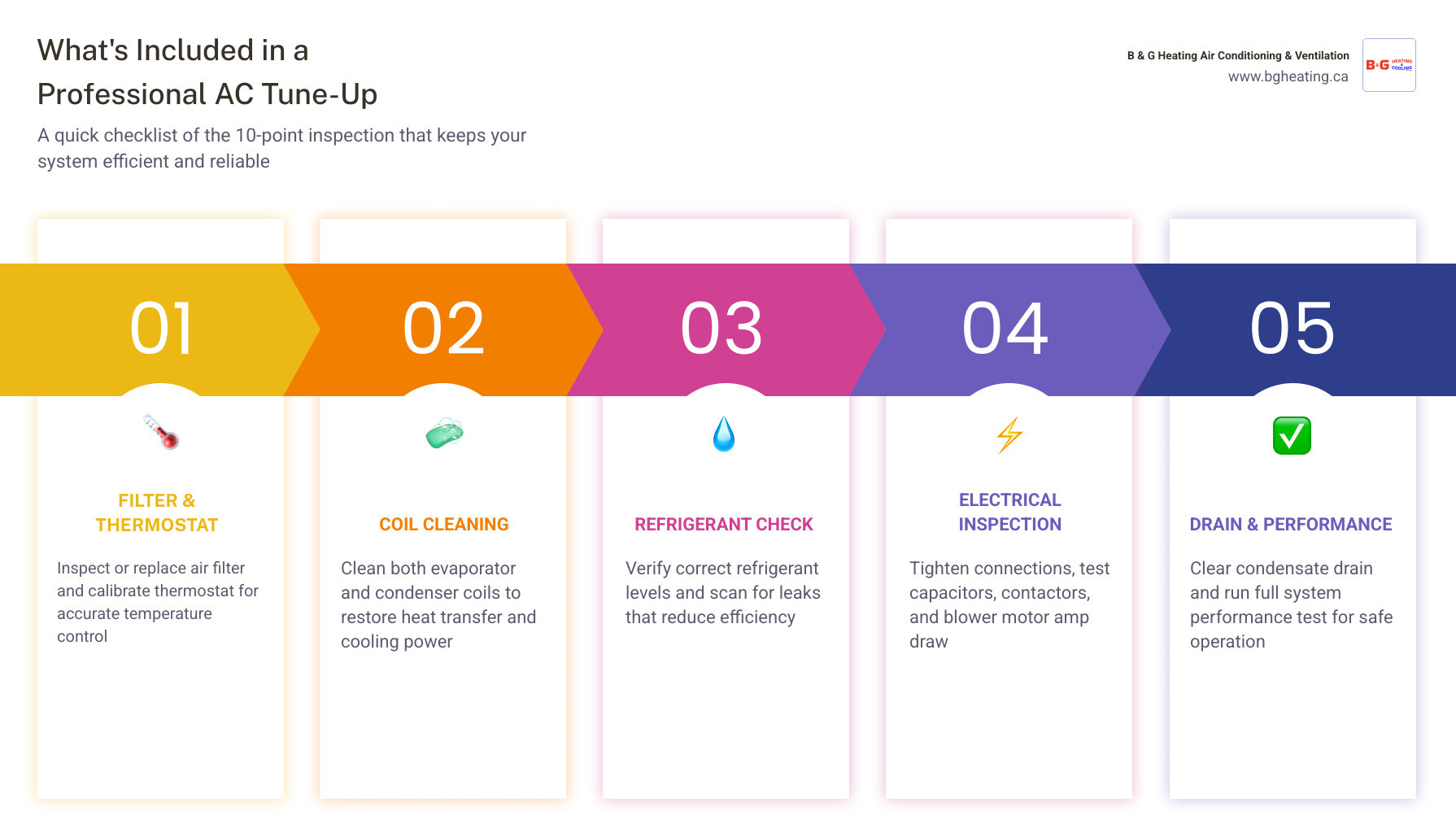
What’s Included in a Professional AC Tune-Up:
- Air filter inspection or replacement — checks for clogs that restrict airflow
- Thermostat calibration — verifies accurate temperature readings and controls
- Evaporator coil cleaning — removes dirt and buildup that reduces cooling efficiency
- Condenser coil cleaning — clears debris from the outdoor unit to improve heat release
- Refrigerant level check — identifies leaks and confirms proper charge
- Electrical connections inspection — tightens and tests wiring, capacitors, and contactors
- Blower motor inspection — checks amp draw and lubrication
- Condensate drain clearing — flushes the drain line to prevent water damage
- Ductwork visual inspection — looks for leaks that waste conditioned air
- Full system performance test — measures temperature split and overall operation
Heating and cooling account for over 52% of a typical home’s annual energy use — and your air conditioner takes on a massive share of that load every summer. Yet most homeowners don’t think about their AC until something goes wrong. By then, a small, fixable problem has often turned into an expensive repair or a breakdown on the hottest day of the year.
A professional AC tune-up is preventive care, not reactive. It’s the difference between a system that runs quietly and efficiently for 15 to 20 years and one that struggles to its 10th birthday. At B & G Heating Air Conditioning & Ventilation, we work with Hamilton homeowners every season to keep their cooling systems running the way they should — before the heat arrives, not after a breakdown forces the call.
This guide walks you through exactly what’s included in a professional AC tune-up, what to expect from the process, and how to make sure you’re getting thorough service every time.

We often use the analogy of a car when talking about home comfort systems. You wouldn’t drive your car for 100,000 kilometers without changing the oil, rotating the tires, or checking the brakes. Your air conditioner is no different. It is a highly complex mechanical system that operates under high pressure and extreme outdoor temperatures.
Skipping regular maintenance is one of the most common reasons air conditioners fail prematurely. When dust, pollen, and outdoor grime accumulate on the internal components, your system has to work significantly harder to cool your home. This extra strain directly impacts your wallet and your comfort.
There are two primary ways to look at the advantages of keeping your system in top shape: the short-term operational perks and the long-term financial protections. Understanding the Benefits of Regular AC Maintenance helps you see that this service is an investment in your home rather than an unnecessary chore.
When you prioritize the Benefits of Preventive AC Maintenance, you secure several key advantages:
- Lower Energy Bills: Regular tune-ups can restore your system’s efficiency, reducing cooling energy costs by 15% to 25%. When coils are clean and parts are lubricated, the system draws less electricity.
- Extended Equipment Lifespan: A well-maintained air conditioner can easily last 15 to 20 years. Neglected systems, on the other hand, often suffer catastrophic compressor failures closer to the 10-year mark.
- Better Indoor Air Quality: Canadians spend about 90% of their time indoors, where pollutant concentrations can actually be 2 to 5 times higher than outdoor levels. Clean filters and coils prevent dust and mold from circulating through your rooms.
- Warranty Protection: Most major HVAC manufacturers explicitly state in their warranty terms that the parts warranty is only valid if the system receives regular, documented professional maintenance.
Recognizing the Signs Your AC Tune Up Is Due Keep Your AC in Top Notch Condition
Sometimes your air conditioner won’t wait for its scheduled spring visit to tell you it needs attention. It will start sending subtle (and sometimes not-so-subtle) warning signs that its internal components are struggling. Knowing how to read these signs can save you from a complete system breakdown in the middle of a July heatwave.
Keep an eye out for these common red flags:
- Weak Airflow: If you hold your hand up to your vents and feel only a faint whisper of air, your blower motor may be failing, or your air filter and evaporator coils could be severely clogged.
- Warm Air Blows From Vents: If your thermostat is set to “cool” but the air coming out feels lukewarm, you could be dealing with low refrigerant levels, a failing compressor, or a faulty capacitor.
- Strange Noises: Squealing, grinding, rattling, or buzzing noises are never normal. They usually point to loose belts, failing motor bearings, or electrical contactors that are wearing out.
- Frequent Cycling: If your AC turns on and off every few minutes without actually cooling your home to the set temperature, it is short-cycling. This places immense wear and tear on your compressor.
If you notice any of these issues, it is time to check out the Signs Your AC Tune Up Is Due Keep Your AC in Top Notch Condition to understand whether you need a standard tune-up or immediate repair service.
How Often Do I Need an AC Unit Tune Up?
The golden rule of HVAC maintenance is simple: your cooling system should be professionally serviced once a year. The ideal time for this is in the early spring, before the hot and humid Ontario summer weather truly sets in.
Scheduling your service early in the year ensures your system is ready to handle high summer temperatures and helps you avoid the mid-summer rush when HVAC companies are flooded with emergency repair calls. If you have a heat pump system that handles both heating and cooling duties, it should actually be serviced twice a year—once in the spring for the cooling side, and once in the autumn for the heating side.
To dive deeper into scheduling timelines and why the seasons play such a major role in your system’s health, you can read our guide on How Often Do I Need an AC Unit Tune Up.
AC Tune-Up Guide: What Is Included in a Professional Inspection
When you hire a professional to perform a tune-up, you shouldn’t just be paying for someone to swap out your air filter and walk away. A true professional service is a highly technical, multi-point inspection that covers both the indoor and outdoor portions of your air conditioning system.
To help homeowners understand what they are paying for, we always point back to our comprehensive Spring Air Conditioner Tune Up Checklist. This checklist ensures that every critical component is inspected, cleaned, and tested for safety and efficiency.
Indoor System Checklist: AC Tune-Up Guide What Is Included
The indoor portion of your air conditioner (usually housed in your basement alongside your furnace or inside a dedicated air handler) is responsible for pulling warm air out of your home, removing its moisture, and sending cooled air back through your vents.
During a professional tune-up, the technician should focus heavily on these critical indoor components:
- The Evaporator Coil: As warm indoor air passes over this cold copper coil, heat is absorbed by the refrigerant inside. Over time, these wet coils collect dust and can quickly become a breeding ground for mold and mildew. The technician will inspect and clean the coil to ensure optimal heat transfer.
- The Blower Motor and Assembly: The blower fan pushes the conditioned air through your ductwork. Technicians measure the motor’s amp draw to ensure it isn’t pulling too much electricity, inspect the blower wheel for dirt buildup (which can reduce airflow by 20% to 30%), and lubricate any moving parts.
- The Condensate Drain Line and Pan: As your AC dehumidifies the air, water collects in a drain pan and flows outside. If this line becomes clogged with algae or dust, it can overflow, causing severe water damage to your basement or furnace. A professional will flush this line and treat it with anti-algae tablets.
- The Thermostat: Your thermostat is the brain of your cooling system. The technician will test its calibration to ensure it is reading the room temperature accurately and verify that all smart or programmable features are operating correctly.
- The Air Filter: A clogged filter chokes off airflow, forcing your system to run longer and hotter. The technician will inspect your filter and replace or clean it as needed.
For practical steps you can take to keep your indoor system running smoothly between professional visits, check out our 4 HVAC Maintenance Tips to Ensure a Seamless Summer Operation.
Outdoor Condenser Checklist: AC Tune-Up Guide What Is Included
The outdoor unit (the condenser) is where the heat extracted from your home is released into the outside air. Because it sits outdoors year-round, it is exposed to wind, rain, dirt, grass clippings, and local wildlife.
A thorough outdoor maintenance routine must include these exact technical steps:
- Powering Down for Safety: Before touching any internal components, the technician will pull the outdoor electrical disconnect to cut high-voltage power to the unit.
- Coil Inspection and Cleaning: The condenser coils are wrapped around the exterior of the unit. If they are coated in dirt or cottonwood seeds, the system cannot dump heat efficiently. The technician will gently wash the coils using a specialized low-pressure rinse to avoid bending the delicate aluminum fins.
- Refrigerant Level Verification: Because your AC is a sealed system, it should never “lose” refrigerant. If levels are low, it always indicates a leak. The technician will measure system pressures, superheat, and subcooling to ensure the charge is exact. Under federal law, if a leak is found, it must be located and repaired rather than simply topped off.
- Electrical Component Testing: This is where the specialized tools come out. The technician will test the run capacitor (the component that gives the compressor and fan the jolt of energy they need to start up). Capacitors are the number one cause of summer breakdowns, and testing them allows us to replace weak ones before they fail completely.
- Contactor Inspection: The contactor is an electrical switch that physically closes to send power to the compressor. Technicians check for pitting, burn marks, or bugs stuck in the contacts.
- Compressor and Fan Motor Amp Readings: By measuring the electrical current (amps) that your compressor and outdoor fan motor draw, we can compare them to the manufacturer’s factory specifications to catch failing motors early.
What to Expect Before, During, and After Your Professional Service
Knowing what happens during a service visit can help you prepare your home and make the most of your time with the technician.
Before the visit: To help things go smoothly, make sure there is a clear, two-foot path around your outdoor condenser unit. Trim back any overgrown bushes or weeds. Indoors, clear a path to your thermostat and your furnace or air handler in the basement. If you have pets, it is always a good idea to secure them in another room before the technician arrives.
During the visit: The technician will start by running your air conditioner in cooling mode for a few minutes to observe its baseline performance. They will then shut down the power to perform the deep cleaning, mechanical adjustments, and electrical testing outlined in our checklists. You may hear the outdoor hose running as they clean the condenser coils.
After the visit: A reputable technician will never just pack up and slip away. They should present you with a detailed, written service report. This report should document their findings, including motor amp draws, capacitor readings, temperature split measurements (which should ideally show a 15 to 20-degree Fahrenheit drop between your return and supply vents), and the overall health of your system. If they spot a worn part, they will explain the issue and provide a solution before it turns into a breakdown.
If you are located in Hamilton, Halton, or Niagara, scheduling a professional AC Tune Up Hamilton ON is the easiest way to secure this peace of mind before summer arrives.
How Long Does a Professional AC Tune-Up Take?
A thorough, professional AC tune-up cannot be rushed. If a technician is in and out of your home in 15 or 20 minutes, they have likely cut corners.
A proper inspection of a single, standard central air conditioning system typically takes between 45 and 90 minutes. This timeframe can vary slightly depending on where your indoor unit is located (such as a tight crawlspace versus an open basement) and how dirty the outdoor coils are. If your system hasn’t been serviced in several years, the deep cleaning process may take a little longer.
For a deeper look into why a proper inspection takes this long and what steps require the most care, you can read our article on the Time for AC Tune Up.
Frequently Asked Questions About AC Maintenance
We hear many of the same questions from homeowners in our service areas, from Ancaster and Burlington to Stoney Creek and Grimsby. To help you navigate your system’s care, we have compiled answers to some of the most common questions. You can also explore our full archive of expert advice under our Tag: AC Tune Up resource section.
What is the difference between an AC tune-up and an HVAC tune-up?
While people often use these terms interchangeably, there is a distinct difference in their scope. An AC tune-up focuses purely on the cooling components of your system. An HVAC (Heating, Ventilation, and Air Conditioning) tune-up is a broader term that can refer to servicing your entire comfort system, often split into two seasonal visits.
Here is a quick comparison of the two service scopes:
| Service Component | AC Tune-Up (Spring/Summer) | Full HVAC Maintenance (Year-Round) |
|---|---|---|
| Primary Focus | Cooling efficiency & summer reliability | Year-round comfort, safety, & efficiency |
| Condenser Coil Cleaning | Yes (Crucial for heat release) | No (Outdoor unit is not used for standard gas heating) |
| Refrigerant Level Check | Yes (Measures pressures & temperatures) | No (Not checked during winter furnace-only visits) |
| Furnace Burner Inspection | No | Yes (Checks combustion and gas connections) |
| Heat Exchanger Safety Test | No | Yes (Checks for cracks that leak carbon monoxide) |
| Thermostat Calibration | Yes (Cooling modes) | Yes (Both heating and cooling modes) |
Can I perform my own air conditioner tune-up?
While we love a good DIY project, a complete AC tune-up is best left to the professionals. There are a few simple tasks you can—and should—do yourself:
- Change your air filters every 30 to 90 days.
- Keep plants, grass, and debris at least two feet away from your outdoor unit.
- Gently hose down the outside of your condenser unit if you notice cottonwood seeds or grass clipping buildup on the exterior fins.
However, checking refrigerant pressures, testing electrical capacitors, measuring motor amp draws, and cleaning delicate internal evaporator coils require specialized training, safety equipment, and precision instruments. Working around high-voltage electricity and pressurized chemicals carries real safety hazards and can void your manufacturer’s warranty if done incorrectly.
How do I know if my service technician is doing a good job?
A great technician stands out through their actions and communication. Here are a few green flags that prove you are dealing with a true professional:
- Punctuality & Communication: They arrive on time or call ahead if they are running behind.
- Respect for Your Home: They wear protective shoe covers and lay down mats to protect your floors.
- Thoroughness: They use a digital multimeter to test electrical parts and connect gauges to check refrigerant levels, rather than just “eyeballing” the unit.
- No Pressure Sales: They explain their findings clearly, show you photos of any worn components, and provide options without resorting to high-pressure scare tactics.
Conclusion
Your air conditioner is one of the most significant investments you will make in your home. Taking care of it with regular, professional maintenance is the single best way to keep your energy bills low, protect your indoor air quality, and prevent stressful summer breakdowns.
As a trusted, family-owned HVAC company serving Hamilton, Hannon, Halton, and the surrounding Niagara communities, we are committed to providing honest workmanship and reliable comfort solutions. Whether you need a seasonal check-up or are looking for expert AC Maintenance Tune Up Hannon ON, our team is here to help keep your home cool and comfortable.
Don’t wait for the first sweltering summer heatwave to find out if your air conditioner is up to the task. Schedule your professional cooling service today and step into the summer season with total peace of mind.