


Why Your Home Feels Sticky Even When the AC Is Running in Southern Ontario
If your ac not keeping up with humidity in a southern ontario summer, you are not alone — and your system may not be broken. The problem is that cooling and dehumidification are two separate jobs, and most standard AC systems struggle to do both well when outdoor humidity peaks.
Here is a quick summary of why this happens and what you can do:
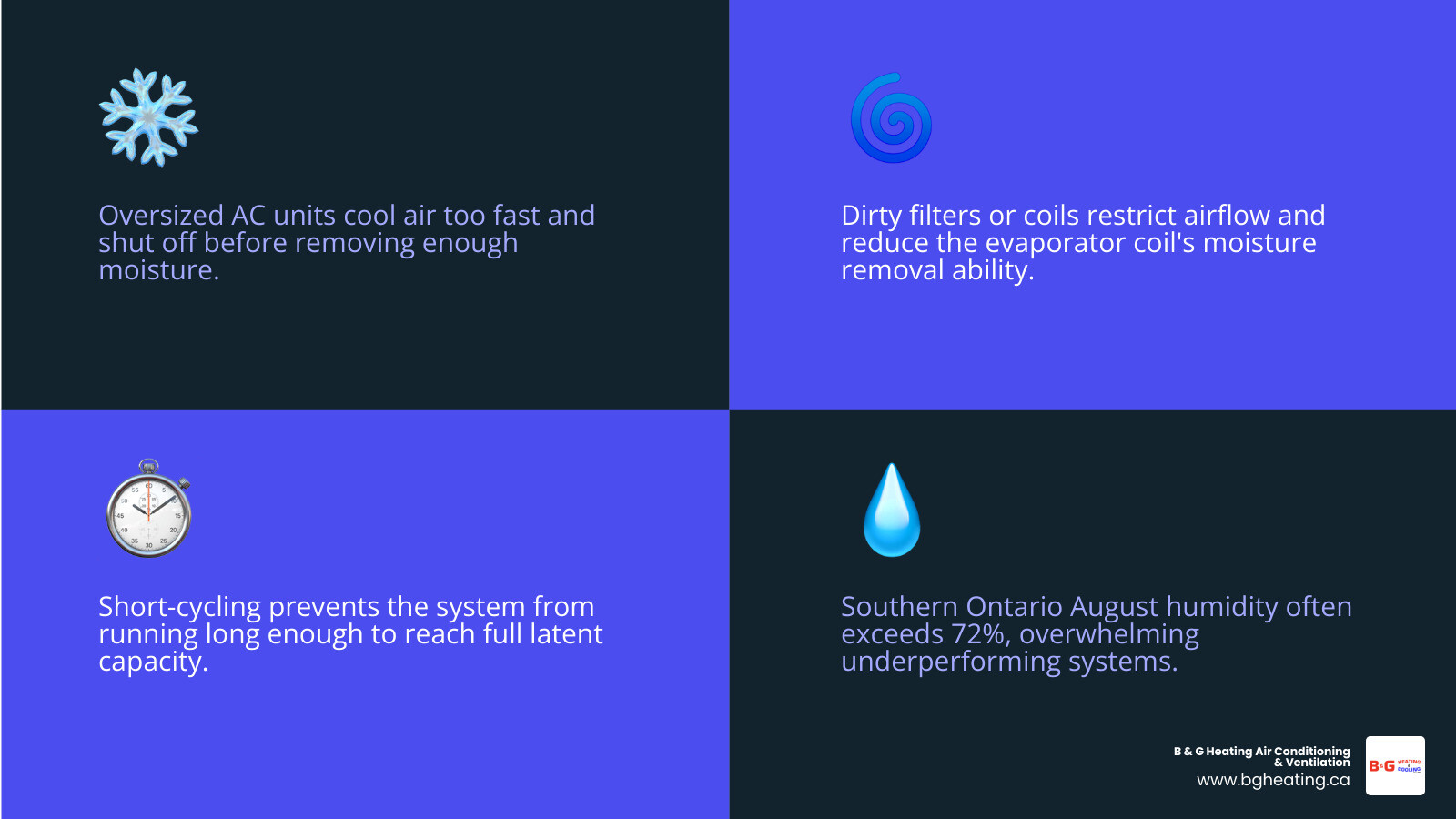
- Oversized AC units cool the air too fast, shut off before removing enough moisture, and leave your home feeling cold but clammy
- Dirty filters or coils restrict airflow, reducing how much moisture the evaporator coil can pull from the air
- Short-cycling prevents the system from running long enough to reach full latent (moisture) removal capacity
- Peak outdoor humidity in Southern Ontario averages over 72% in August, overwhelming systems that are already underperforming
- Air leaks and poor insulation allow humid outdoor air to constantly seep back inside
The ideal indoor humidity level is between 45% and 55% during summer. If your home is sitting above 60%, you are in the range where mold growth, musty odors, and respiratory irritation become real concerns.
Many homeowners assume their AC is failing when they feel sticky indoors. In reality, the system may be hitting the temperature target just fine — but shutting off before it has had time to pull moisture out of the air. A properly sized, well-maintained system running long enough cycles should keep indoor relative humidity under 50% during peak cooling hours. When it cannot, there are specific, fixable reasons why.
Why Your AC Is Not Keeping Up With Humidity in a Southern Ontario Summer

To solve the mystery of why your home feels like a tropical rainforest even when the thermostat says 22°C, we have to look at how an air conditioner actually works. Many of us think of our AC as a machine that pumps “coldness” into our homes. In reality, it is a heat and moisture extraction machine.
An air conditioner cools your home by absorbing sensible heat (the heat you can feel on a thermometer) and latent heat (the energy held by moisture in the air). As warm, humid indoor air is pulled across the freezing cold evaporator coil of your system, the moisture in the air hits its dew point and condenses onto the coil—much like water droplets forming on a cold can of pop on a hot July afternoon in Hamilton. This condensed moisture drips down into a condensate pan and drains safely out of your home.
However, if your air conditioner runs into mechanical or design issues, this delicate balance of heat and moisture removal falls apart. This is when you start dealing with Common AC Problems in Summer.
When your system experiences issues like low refrigerant, dirty coils, or failing blower motors, it becomes an AC Not Cooling Effectively. If the cooling coil does not get cold enough, or if the air moves past it too quickly, the moisture in the air won’t condense. The result? Your system blows cool, but highly humid air back into your living spaces, leaving you feeling sticky and uncomfortable.
How Oversized Systems Cause Your AC Not Keeping Up With Humidity in a Southern Ontario Summer
In the HVAC world, bigger is definitely not always better. One of the most common reasons for an ac not keeping up with humidity in a southern ontario summer is an oversized system.
When an air conditioner is too large for a home, it cools the house down incredibly fast. It turns on, blasts a wave of freezing air, hits the thermostat’s target temperature in 5 to 10 minutes, and shuts down. This rapid on-and-off sequence is called short-cycling.
A cooling coil actually requires about 20 to 30 minutes of continuous operation to reach its optimal temperature and begin pulling significant moisture out of the air. If your system only runs in short 8-minute bursts, it satisfies the thermostat’s temperature setting long before it has had a chance to extract any water vapor. This leaves you with cold, clammy, and heavy air. If you suspect this is happening in your home, you can learn more about this behavior by reading AC Keeps Turning On and Off What’s Wrong.
Airflow Restrictions and Your AC Not Keeping Up With Humidity in a Southern Ontario Summer
Another major culprit behind poor dehumidification is restricted airflow. For your air conditioner to remove humidity, a steady, balanced volume of warm indoor air must pass over the cold evaporator coil.
If your furnace or air handler filter is packed with dust, pet dander, and hair, the airflow slows to a crawl. When airflow is restricted:
- The air cannot pass over the coil fast enough to distribute cooling evenly.
- The evaporator coil gets too cold because there is not enough warm air passing over it to transfer heat, which can lead to ice forming on the coil.
- The system is unable to process the total volume of humid air in your home, leading to high indoor humidity levels.
Keeping your system clean and clear is the simplest way to prevent this. To keep your system running smoothly, check out our guide on How to Help Your Air Conditioner Run More Efficiently.
The Science of Summer Humidity in Southern Ontario
Southern Ontario has a unique geographic profile that makes our summers incredibly muggy. Nestled between Lake Ontario, Lake Erie, and Lake Huron, our region acts like a giant moisture sponge during the hot summer months. Whether you live in Burlington, Oakville, Mississauga, or St. Catharines, you are never far from a massive body of water feeding moisture into the atmosphere.
During August, the outdoor relative humidity in Southern Ontario averages a whopping 72.42%. In the early morning hours, it is not uncommon for humidity levels to exceed 90% in lakefront communities. When the outdoor air holds that much moisture, the “dew point”—the temperature at which air becomes saturated and water condenses—rises significantly.
When the outdoor dew point is high, moisture is constantly trying to find its way into your cooler, lower-pressure indoor air through gaps in doors, windows, and foundations. If your AC is not operating at peak efficiency, it simply cannot keep up with this constant moisture infiltration.
| Measurement Type | Ideal Indoor Summer Conditions | Peak Southern Ontario Summer (Outdoor) | Impact of Inbalance |
|---|---|---|---|
| Relative Humidity (RH) | 45% – 55% | 72% – 90%+ | Levels above 60% lead to mold risk, musty odors, and skin that feels sticky. |
| Dew Point | 10°C – 13°C (50°F – 55°F) | 20°C – 24°C+ (68°F – 75°F+) | High dew points make the air feel heavy and force your AC to work twice as hard. |
| Perceived Temperature | Feels like 22°C | Feels like 30°C+ (due to Humidex) | High indoor humidity prevents sweat from evaporating, making a 22°C room feel like 26°C. |
Signs Your Cooling System is Struggling with Moisture Control
Sometimes, it is hard to tell if your indoor air is actually too humid or if you are just feeling the heat after a long day outside. However, your home will start dropping clues when your air conditioner is losing the battle against humidity.
Keep an eye out for these common warning signs:
- Condensation on Windows and Metal Surfaces: If you notice water beads or fog forming on the inside of your window panes, your indoor relative humidity is likely well above 60%.
- Musty, Damp Odors: High humidity creates a breeding ground for mold and mildew in dark corners, carpets, and ductwork, resulting in a distinct “basement-like” smell.
- Sticking Doors and Windows: Wooden doors and window frames absorb excess moisture from the air, causing them to swell and stick in their frames.
- Peeling Paint or Bubbling Wallpaper: Moisture trapped behind wall coverings will weaken adhesives and paint bonds, causing them to flake, peel, or bubble.
- Clammy Skin and Sleepless Nights: If you feel damp or sticky even when sitting directly under an AC vent, your system is failing to dehumidify.
Ignoring these warning signs can lead to structural damage to your home and poor indoor air quality. If you notice these physical changes alongside poor cooling performance, it is time to check out Signs Your AC Needs Immediate Repair and learn how to begin Identifying Common AC Issues.
Practical Steps to Improve Humidity Control Without Replacing Your AC
If your ac not keeping up with humidity in a southern ontario summer, you do not necessarily have to run out and buy a brand-new system. There are several highly effective, low-cost steps you can take to ease the moisture load on your existing air conditioner:
- Leverage Your Exhaust Fans: Always run your bathroom exhaust fans during and for 20 minutes after showers, and use your kitchen range hood while cooking. These activities release massive amounts of moisture directly into your indoor air.
- Seal Up the Air Leaks: Use caulk and weatherstripping to seal gaps around windows, exterior doors, and basement rim joists. Preventing humid outdoor air from sneaking inside reduces the work your AC has to do.
- Close the Blinds and Curtains: Install thermal blinds or blackout curtains on south- and west-facing windows. This lowers the sensible heat gain in your home, allowing your AC to run more balanced, steady cycles rather than dealing with rapid heat spikes.
- Keep Your Thermostat Fan on “Auto”: Never set your thermostat fan to “ON” during a humid summer. When the fan runs constantly, it blows air over the wet evaporator coil during the off-cycle, evaporating the water that was just extracted right back into your home. Always use the “AUTO” setting.
- Check for a Frozen Coil: If your system’s airflow is restricted, the coil can freeze solid, blocking all dehumidification. If you suspect this has happened, read up on How to Handle Your Air Conditioner When It’s Frozen to thaw it safely and restore performance.
Upgrading to Whole-Home Dehumidification and Variable-Capacity Systems
For many homes in Southern Ontario—especially older brick homes in Hamilton, Dundas, or Stoney Creek, or properties close to the water in Grimsby and Niagara-on-the-Lake—passive steps may not be enough during peak summer heatwaves. That is where targeted equipment upgrades come in.
A whole-home dehumidifier is integrated directly into your existing ductwork. It works alongside your air conditioner, pulling moisture out of the air even when the AC is not actively running a cooling cycle. This is incredibly helpful on warm, rainy spring or summer days when the indoor temperature is comfortable, but the humidity is sky-high. By taking over the moisture-removal duties, a dedicated dehumidifier allows your AC to run more efficiently, saving you wear and tear on your cooling system.
If you are planning to replace your air conditioner in the near future, we highly recommend looking into variable-capacity (or variable-speed) systems.
Traditional single-stage air conditioners are either 100% on or completely off. Variable-capacity systems, however, can modulate their output anywhere from 30% to 100%. On a typical humid summer day, a variable-speed system will run almost continuously at a lower, ultra-efficient speed. This long, steady run-time ensures that air is constantly passing over the cold cooling coil, maximizing moisture extraction and eliminating the cold, clammy feeling associated with short-cycling.
If you are noticing that your system is running constantly but still leaving you sticky, or if you are wondering Why Is Your AC Not Shutting Off?, it could be a sign of a system struggling to meet demand, or it could be a highly efficient variable-speed system doing exactly what it was designed to do to keep your home dry and comfortable.
Frequently Asked Questions About Summer Humidity
What is the ideal indoor humidity level during a Southern Ontario summer?
For optimal comfort, health, and home preservation, you should aim to keep your indoor relative humidity between 45% and 55% during the summer months.
Keeping your humidity in this sweet spot ensures that your skin can naturally cool itself through evaporation, making your home feel comfortable even at slightly higher temperature settings. Additionally, keeping relative humidity strictly below 60% is essential for preventing the growth of mold, mildew, and dust mites, which can trigger allergies and respiratory issues.
Can a dirty air filter cause high indoor humidity?
Yes, absolutely. A dirty air filter restricts the volume of air flowing through your HVAC system. When airflow is choked, your air conditioner cannot pull the humid air out of your rooms fast enough to process it.
Furthermore, the lack of warm airflow causes the temperature of the evaporator coil to drop rapidly. This often leads to the condensate freezing on the coil, turning your air conditioner into a block of ice. Once the coil freezes, it can no longer remove heat or moisture from the air. If you are dealing with this issue, check out our guide on Troubleshooting Frozen AC Unit for step-by-step help.
When is it too humid to open windows at night in Ontario?
As a general rule of thumb, you should keep your windows closed if the outdoor relative humidity is above 55% to 60%, even if the temperature outside feels cool.
It is incredibly tempting to turn off the AC and open the windows on a cool summer night in Southern Ontario. However, our morning humidity levels often exceed 90%. If you open your windows, your home’s drywall, carpets, and furniture will act like a sponge, soaking up massive amounts of moisture overnight. When the sun comes up and the temperature rises, your AC will have to work twice as hard—consuming significantly more energy—just to wring that moisture back out of your home.
Conclusion
Managing indoor moisture during our hot, muggy summers is about much more than just lowering the temperature on your thermostat. When your ac not keeping up with humidity in a southern ontario summer, it is a sign that your system needs a little attention to restore its moisture-removing capabilities. From cleaning restricted filters and fixing airflow issues to upgrading to a whole-home dehumidifier or a variable-capacity system, you have plenty of options to make your home comfortable again.
At B & G Heating Air Conditioning & Ventilation, we have been helping families across Hamilton, Burlington, Oakville, Grimsby, and the surrounding areas stay cool and dry for years. We understand the unique demands that our Great Lakes climate places on residential cooling systems, and we are committed to providing honest, high-quality solutions tailored to your home.
Preventative care is the best way to ensure your system is ready to handle the summer mugginess. Learn more about the Benefits of Regular AC Maintenance and see how a professional tune-up can keep your home dry and comfortable all summer long.
Ready to banish the sticky, heavy air from your home? Schedule your indoor comfort consultation today with our friendly, expert team at B & G Heating Air Conditioning & Ventilation, and let us help you find the perfect humidity control solution for your home!