


Is Replacing Your AC in Ontario Actually Worth It?
How energy savings from a new AC unit offset replacement in Ontario is a question many Hamilton-area homeowners are asking right now — and for good reason. If your air conditioner is more than 10–15 years old, it could be costing you significantly more to run each summer than a newer model would. Here is a quick answer before we dive deeper:
How a New AC Unit Pays for Itself in Ontario:
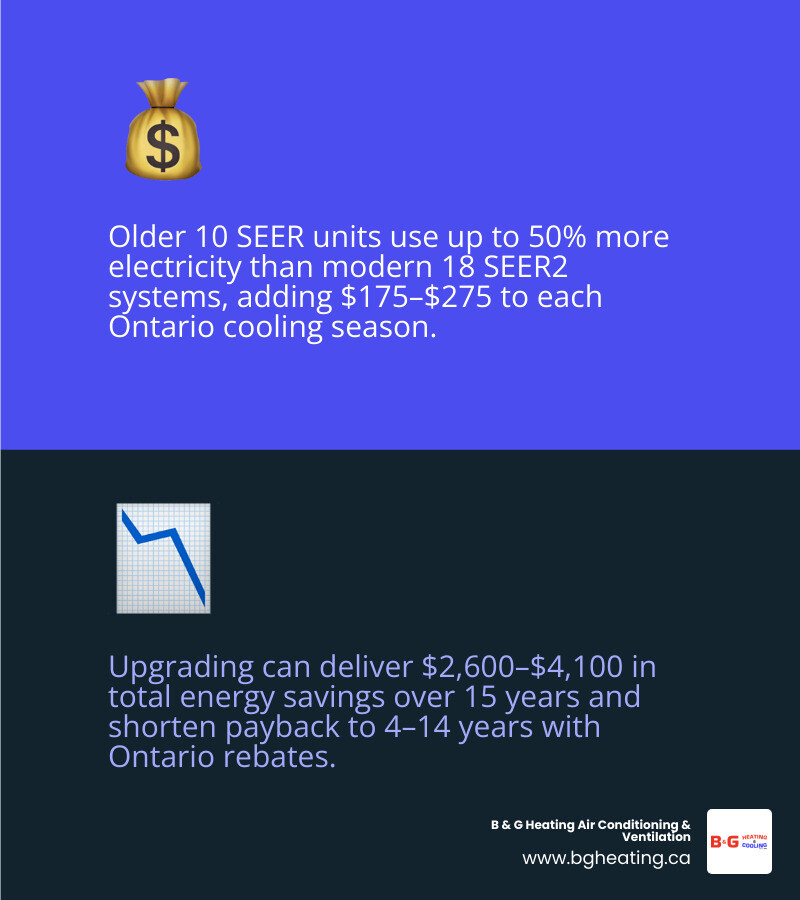
- Older units (10 SEER or below) use up to 50% more electricity than a modern 18 SEER2 system
- Upgrading from a 10 SEER to an 18 SEER2 unit can save roughly $175–$275 per cooling season
- Over 15 years, that adds up to $2,600–$4,100 in energy savings
- Ontario rebate programs can reduce your upfront cost, shortening the payback period significantly
- Typical payback periods range from 4–14 years depending on your current unit, home size, and usage
Ontario summers are getting hotter, and over 83% of Ontario households now rely on air conditioning. That means your AC is one of the biggest drivers of your summer hydro bill. According to energy research, cooling alone can account for roughly one-third of all electricity used across Ontario on peak summer days — and summer bills often climb 40–50% compared to other seasons.
An aging, inefficient unit running through those hot months is quietly draining money that could be working for you instead. Understanding the math behind an upgrade — savings, payback period, and available rebates — is the smartest first step any Ontario homeowner can take before making a decision.
How energy savings from a new ac unit offset replacement in ontario terminology:
When to Choose Upgrading Over Constant Repairs

Every summer, homeowners across Hamilton, Burlington, and Oakville face the same dilemma: do you patch up your aging air conditioner one more time, or do you finally invest in a replacement? It is easy to fall into the trap of choosing the quick fix, but those band-aid repairs can quickly add up to more than the system is actually worth.
To make an informed decision, we highly recommend checking out The Ultimate Guide to AC Repair vs Replace and reviewing our guide on When to Consider AC Replacement.
When evaluating your current unit, consider these three critical factors:
- System Age: The Average Lifespan of Central AC in Ontario is typically 15 to 17 years. If your system is past the 10-to-12-year mark, its internal components are already operating well below their original efficiency ratings.
- The R-22 Refrigerant Dilemma: Older air conditioners installed before 2010 rely on R-22 refrigerant (commonly known as Freon). Since R-22 is completely phased out and no longer manufactured in Canada, recharging a leaky, old system is incredibly expensive. Sinking money into obsolete refrigerant for a failing unit is rarely a sound financial choice.
- Mechanical Wear and Tear: As compressors, fan motors, and capacitors age, they require more electrical current to start up and run. This mechanical wear means your old AC is working harder and consuming far more electricity just to deliver the same level of cooling.
A great rule of thumb is the “5,000 Rule.” Multiply the age of your air conditioner by the quoted repair cost. If the result exceeds $5,000, replacing the system is almost always the more economical long-term choice.
How Energy Savings from a New AC Unit Offset Replacement in Ontario
When your cooling system is running smoothly, it is easy to ignore. However, understanding the Importance of AC Replacement goes beyond avoiding a sudden breakdown during a July heatwave. It is about taking control of your monthly utility bills.
Modern air conditioners are vastly superior to the models built a decade ago. When Choosing the Right AC Replacement, you will notice that new systems utilize advanced technology designed to minimize wasted power:
- SEER2 Ratings: The Seasonal Energy Efficiency Ratio 2 (SEER2) is the updated industry standard. It measures a system’s cooling efficiency under realistic duct pressure conditions. Modern minimum-standard units start around 13.8 to 14.3 SEER2, while high-efficiency systems can reach 18 to 22 SEER2.
- Variable-Speed Compressors: Traditional air conditioners are either 100% on or 100% off. They blast cold air, turn off, and turn back on when the temperature rises. This “short-cycling” consumes massive amounts of electricity. Modern variable-speed systems adjust their output incrementally, running at lower, whisper-quiet speeds for longer periods. This keeps your home at a perfectly consistent temperature while using up to 30% to 50% less energy.
To see how these efficiency gains translate to real-world power consumption, look at the differences in seasonal energy use:
| Equipment Generation | Efficiency Rating | Average Seasonal Savings | Estimated 15-Year Cumulative Savings |
|---|---|---|---|
| Older System (Pre-2006) | 10 SEER | Baseline | Baseline |
| Modern Mid-Efficiency | 14 SEER2 | $100 – $160 / year | $1,500 – $2,400 |
| Modern High-Efficiency | 18 SEER2 | $175 – $275 / year | $2,600 – $4,100 |
| Modern Ultra-High-Efficiency | 22 SEER2 | $295+ / year | $4,425+ |
As you can see, how energy savings from a new ac unit offset replacement in ontario is not just marketing speak—it is verifiable math. Over the lifespan of a modern system, the electricity you do not buy goes a long way toward paying back your initial investment.
Calculating the Payback Period for Your Upgrade
A payback analysis determines the exact number of years it takes for your annual energy savings to completely cover the net purchase cost of your new air conditioner.
To calculate your personal payback period, use this simple formula:
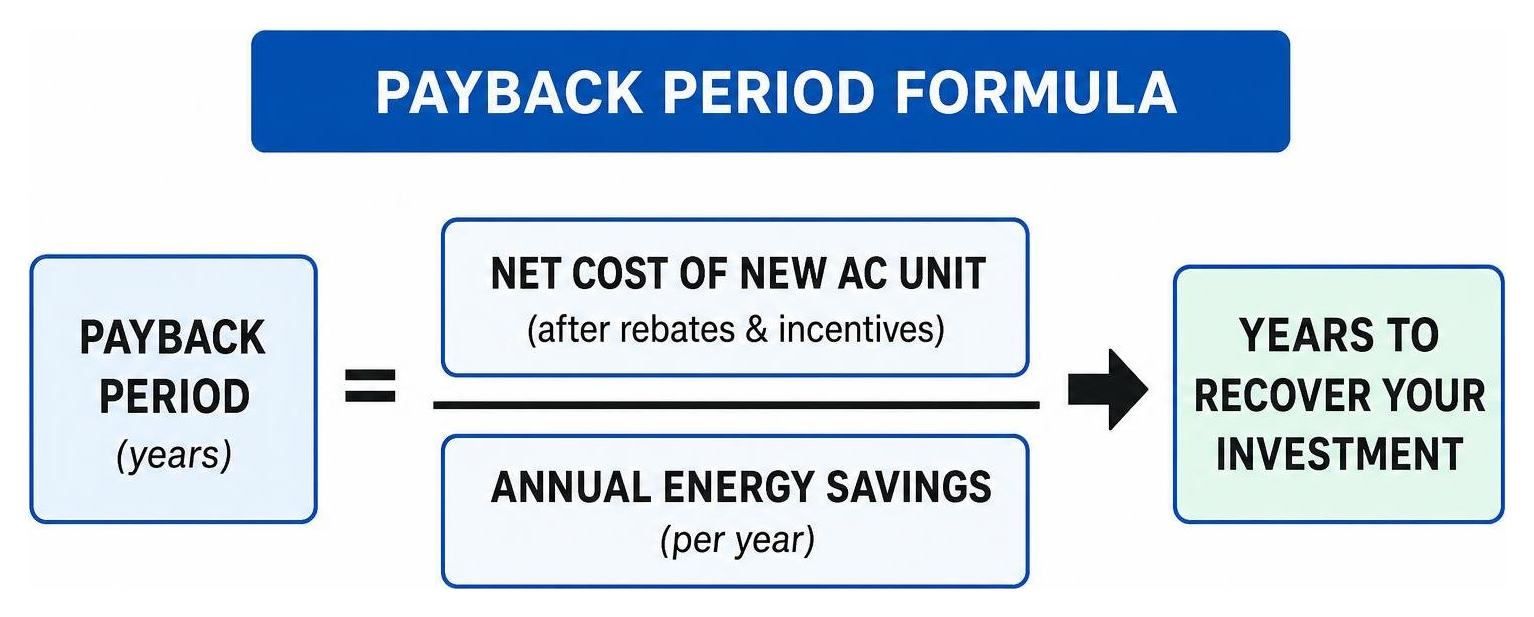
For example, if the net cost of upgrading to an 18 SEER2 system (after applying all eligible rebates) is offset by an annual hydro savings of $250, your payback period is incredibly straightforward.
Your local cooling hours play a huge role in this calculation. In Southern Ontario—especially in areas close to Lake Ontario like Stoney Creek, Grimsby, and St. Catharines—the “lake effect” creates high humidity. This means your air conditioner has to run longer to extract moisture from the air, often logging 1,800 to 2,200 operating hours per season. The more your system runs, the faster a high-efficiency unit pays for itself.
How Energy Savings from a New AC Unit Offset Replacement in Ontario for Older Homes
The age and condition of your home directly impact how much energy you can save. If you live in an older home in Hamilton, Dundas, or Ancaster, your house likely has a more sensitive “thermal envelope.”
To maximize your investment, it helps to understand How to Help Your Air Conditioner Run More Efficiently. Upgrading your AC is highly effective, but pairing it with basic home improvements creates an unbeatable efficiency combo:
- Attic Insulation: Heat from the summer sun bakes your roof and radiates down into your living spaces. Ensuring your attic has adequate insulation keeps that heat out, reducing the load on your new AC.
- Duct Sealing: Leaky ductwork in unconditioned spaces (like basements or crawlspaces) can waste up to 20% to 30% of your cooled air before it ever reaches your rooms.
- Home Size and Layout: Larger homes require larger tonnage systems. Because larger systems consume more power, the gap in energy use between an old 10 SEER unit and a new 18 SEER2 unit is magnified. If you have a 2,500-square-foot home, your annual dollar savings will be significantly higher than those of a smaller townhouse, accelerating your payback timeline.
How Energy Savings from a New AC Unit Offset Replacement in Ontario Under Time-of-Use Rates
Ontario’s electricity pricing structure is uniquely designed to reward energy-efficient habits. Most homeowners in Mississauga, Brampton, and Kitchener are on Time-of-Use (TOU) billing, where electricity prices peak during the hottest parts of the day—exactly when older, single-stage air conditioners run at maximum capacity.
To keep your bills manageable, read up on the Best Ways to Save Money When Running Your AC This Summer and explore these 4 Definitive Ways to Avoid Paying Hefty Air Conditioning Bills.
Here is how modern technology interacts with Ontario’s rate structures:
- Beating the Peak Rates: On-peak hydro rates can be double the cost of off-peak rates. Because variable-speed air conditioners run continuously at ultra-low, highly efficient speeds, they avoid the massive power spikes that occur when an old system constantly restarts during peak afternoon hours.
- Ultra-Low Overnight (ULO) Rates: If your municipality offers the ULO rate plan, you can pre-cool your home during the cheapest overnight hours. A highly efficient, modern system can maintain that cool temperature well into the next day with minimal power consumption, shifting your energy use away from expensive daytime peak periods.
Leveraging Ontario Rebates and Incentives to Accelerate Payback
The secret to achieving a rapid payback period is reducing your net upfront cost. Fortunately, in 2026, Ontario homeowners have access to several incredible incentive programs designed to encourage energy-efficient upgrades.
To navigate these options, start with The Ultimate Guide to Rebates for AC Replacement in Ontario.
Here are the primary programs you should look into:
- The Canada Greener Homes Initiatives: While the original grant program has evolved, interest-free financing through the Canada Greener Homes Grant program remains a powerful tool. Homeowners can access interest-free loans to help fund high-efficiency heat pump installations.
- Heat Pump Transitions: If you choose to replace your traditional central AC with an air-source heat pump, you may qualify for substantial provincial and utility incentives. Check out the Canada Greener Homes Grant Eligibility for Heat Pump Installation Ontario 101 to see how a heat pump can handle both your summer cooling and winter heating.
- Enbridge Home Efficiency Rebate (HER+): Enbridge Gas, in partnership with provincial programs, regularly offers rebates for homeowners who complete certified energy assessments and upgrade to qualified, high-efficiency hybrid heating and cooling systems.
By stacking manufacturer promotions with utility rebates, you can shave years off your payback period, making the transition to high-efficiency cooling an absolute financial no-brainer.
Maximizing Long-Term Efficiency and Lifespan
Once your new high-efficiency air conditioner is professionally installed, your goal is to keep it running at peak performance for the next two decades.
To do this, you need to know How to Make Your HVAC Systems Work Efficiently and follow proven strategies for Prolonging AC System Lifespan.
- The Power of Preventive Maintenance: Never underestimate the Benefits of Preventive HVAC Maintenance and Why You Shouldn’t Be Ignoring It. Just like a car, an air conditioner needs regular tune-ups to maintain its efficiency ratings.
- Protecting Your Investment in Winter: Our local climate brings harsh, freezing winters. Understanding How Maintenance Extends AC Life in Canadian Winters will prevent outdoor coil damage from heavy ice and snow accumulation.
- Professional Coil Cleaning: Over the summer, dirt, pollen, and outdoor debris clog your outdoor condenser coils. Studies show that professional coil cleaning can improve your system’s operating efficiency by 10% or more, directly lowering your monthly electricity bills.
- Smart Thermostats: Upgrading to a smart thermostat allows you to program cooling schedules around your daily routine. By automatically raising the temperature a few degrees when you are at work and cooling the house right before you arrive home, you can reduce your seasonal cooling costs by an additional 10% to 15%.
Frequently Asked Questions About AC Replacement in Ontario
How long does a typical central air conditioner last in Ontario?
In Southern Ontario, a well-maintained central air conditioner typically lasts between 15 and 17 years. However, units that do not receive regular maintenance or are forced to run with clogged filters and dirty coils may begin to fail as early as year 10. Conversely, high-efficiency models with variable-speed compressors experience less mechanical stress and can easily last 18 to 22 years when properly cared for.
Should I replace my furnace at the same time as my air conditioner?
While it is not strictly mandatory, it is highly recommended in most cases. Your air conditioner’s indoor evaporator coil sits directly on top of your furnace, and they share the same blower motor to distribute air. Pairing a brand-new, high-efficiency 18 SEER2 air conditioner with an old, single-speed furnace blower motor means you will never actually achieve that high efficiency rating. Replacing them together ensures perfect system compatibility, optimizes airflow, and saves you money on combined installation labor.
What is the difference between SEER and SEER2 ratings?
To get a full breakdown of how efficiency is measured, read our guide to Understand Heat Pump Efficiency SEER Rating Explained. In short, SEER2 is the new testing standard implemented in 2023. The old SEER test did not account for the real-world static pressure created by a home’s ductwork. SEER2 testing uses much more realistic pressure parameters, meaning a SEER2 rating is a far more accurate representation of the actual efficiency you will experience in your home.
Conclusion
Investing in a new, high-efficiency air conditioner is one of the most practical home improvements you can make. When you look at how energy savings from a new ac unit offset replacement in ontario, the financial benefits are clear. Between immediate drops in your monthly hydro bills, protection against costly emergency repairs, and the help of local rebate programs, a modern system quickly pays for itself.
At B & G Heating Air Conditioning & Ventilation, we have spent years helping families across Hamilton, Burlington, Oakville, and the surrounding Niagara and Golden Horseshoe regions stay comfortable while saving money. As a trusted, family-owned HVAC company, our focus is always on quality workmanship, honest advice, and complete customer satisfaction.
If you are ready to stop overpaying on your summer utility bills, we are here to help. Explore our professional cooling services today or reach out to our team to schedule your personalized home energy assessment!