


Why is my air conditioner struggling in the heat? Who offers reliable AC tune-ups in Hamilton?
Why ac tune-ups prevent breakdowns during the first heat wave of summer comes down to one simple truth: your air conditioner doesn’t fail on mild days. It fails when the heat finally hits hard — and it’s been sitting idle for months with nobody checking what’s wearing out inside.
Quick Answer: How a Tune-Up Prevents Heat Wave Breakdowns
- Catches weak components early — A technician tests capacitors, electrical connections, and motors before they fail under sustained high-load operation
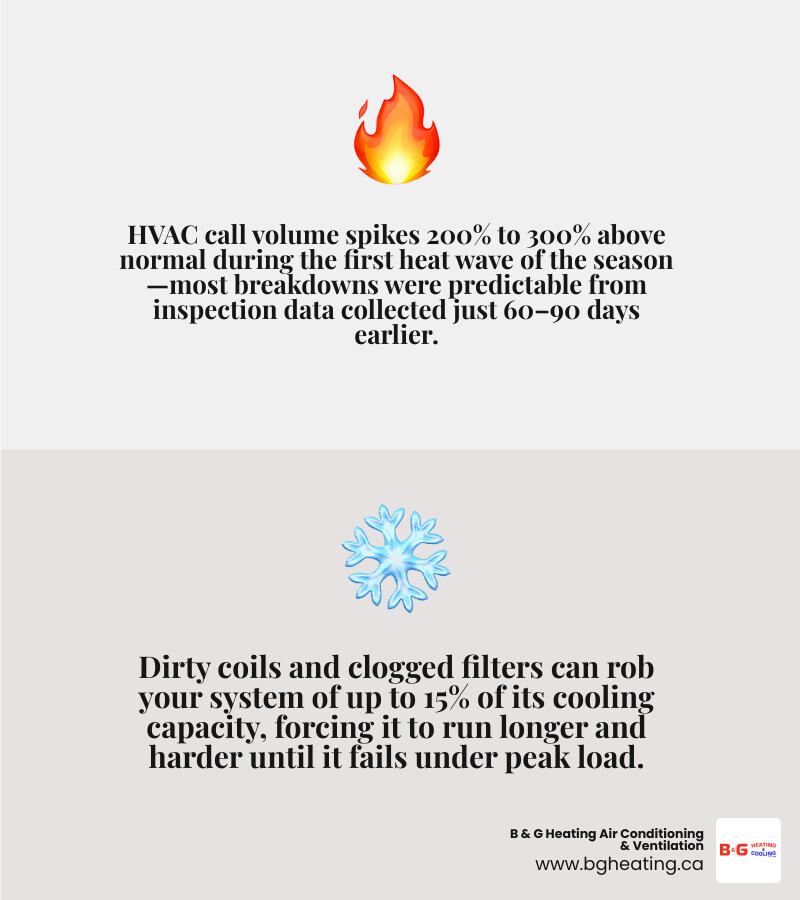
- Restores lost efficiency — Dirty coils and clogged filters can rob your system of up to 15% of its cooling capacity without you knowing
- Verifies refrigerant charge — A system low on refrigerant will freeze up or shut down entirely when pushed hard in extreme heat
- Clears condensate drains — A backed-up drain line trips a safety switch that shuts the whole system off, often on the hottest day of the year
- Identifies problems while parts are available — Finding a failing part in spring means a quick fix; finding it in July means days of waiting in a hot house
Here’s the uncomfortable reality: up to 80% of major AC repairs trace back to skipped routine maintenance. And 80% of peak-season failures are predictable from inspection data collected just 60 to 90 days earlier. That means most homeowners sitting in a hot house in July were already showing warning signs in April — they just didn’t know it.
For Hamilton homeowners, this matters even more. Southern Ontario summers bring high humidity from the Great Lakes on top of the heat, which puts extra strain on every part of your cooling system. When a system hasn’t been serviced, that first real heat wave doesn’t just test it — it breaks it.
HVAC call volume spikes 200% to 300% above normal during the first heat wave of the season. At that point, wait times stretch for days, emergency service is required, and your family is stuck waiting. A spring tune-up from B & G Heating Air Conditioning & Ventilation is how you make sure that call never happens.
Basic why ac tune-ups prevent breakdowns during the first heat wave of summer vocab:
Why Air Conditioners Fail During the First Heat Wave of Summer
To understand why air conditioners break down during that first intense stretch of July heat, we have to look at what happens during the preceding eight months. In Southern Ontario locations like Burlington, Oakville, and Hamilton, your cooling system sits completely dormant from October until May. It is during this long hibernation that the stage is set for a mid-summer breakdown.
Winter Hibernation and Environmental Stress
Throughout the autumn and winter, your outdoor condenser unit is exposed to freezing temperatures, heavy snow, ice, and windblown debris. Mice, chipmunks, and other small critters often view the quiet interior of a dormant AC unit as a cozy winter condo. They chew through electrical wiring, build nests that restrict airflow, and leave behind corrosive waste.
Simultaneously, fine dust, pollen, and lawn clippings settle deep into the aluminum fins of the outdoor condenser coil. This accumulation creates an insulating blanket around the coils. When you switch the unit on for the first time, this dirt prevents the system from releasing heat efficiently.
Thermal Expansion and Electrical Resistance
As the outdoor temperature swings from winter freezes to hot summer afternoons, the metal components within your AC expand and contract. This natural process is known as thermal cycling. Over time, thermal cycling causes electrical terminals to expand and contract, loosening screw terminals and wire connections.
When electrical connections loosen, they create electrical resistance. When electricity tries to flow through a loose wire, it generates localized heat. Under mild spring conditions, this resistance might only cause a minor voltage drop. However, during a sustained heat wave, when the system runs continuously, this resistance can melt wire insulation, trip circuit breakers, or burn out delicate control boards.
The Continuous Runtime Stress Test
During mild spring weather, your AC might only run for 10 to 15 minutes at a time to take the edge off a warm afternoon. The system has plenty of “off-cycles” to cool down.
When the first major heat wave of the summer arrives, the demand changes instantly. Your system is suddenly asked to run for 12 to 18 hours a day, sometimes without a single break. This continuous runtime acts as an aggressive mechanical and electrical stress test. Any minor, pre-existing weakness—a slightly degraded capacitor, a tiny refrigerant leak, or a thin layer of dust on the coils—is pushed past its operating limit, resulting in a sudden, catastrophic shutdown.
The Science of Why AC Tune-Ups Prevent Breakdowns During the First Heat Wave of Summer
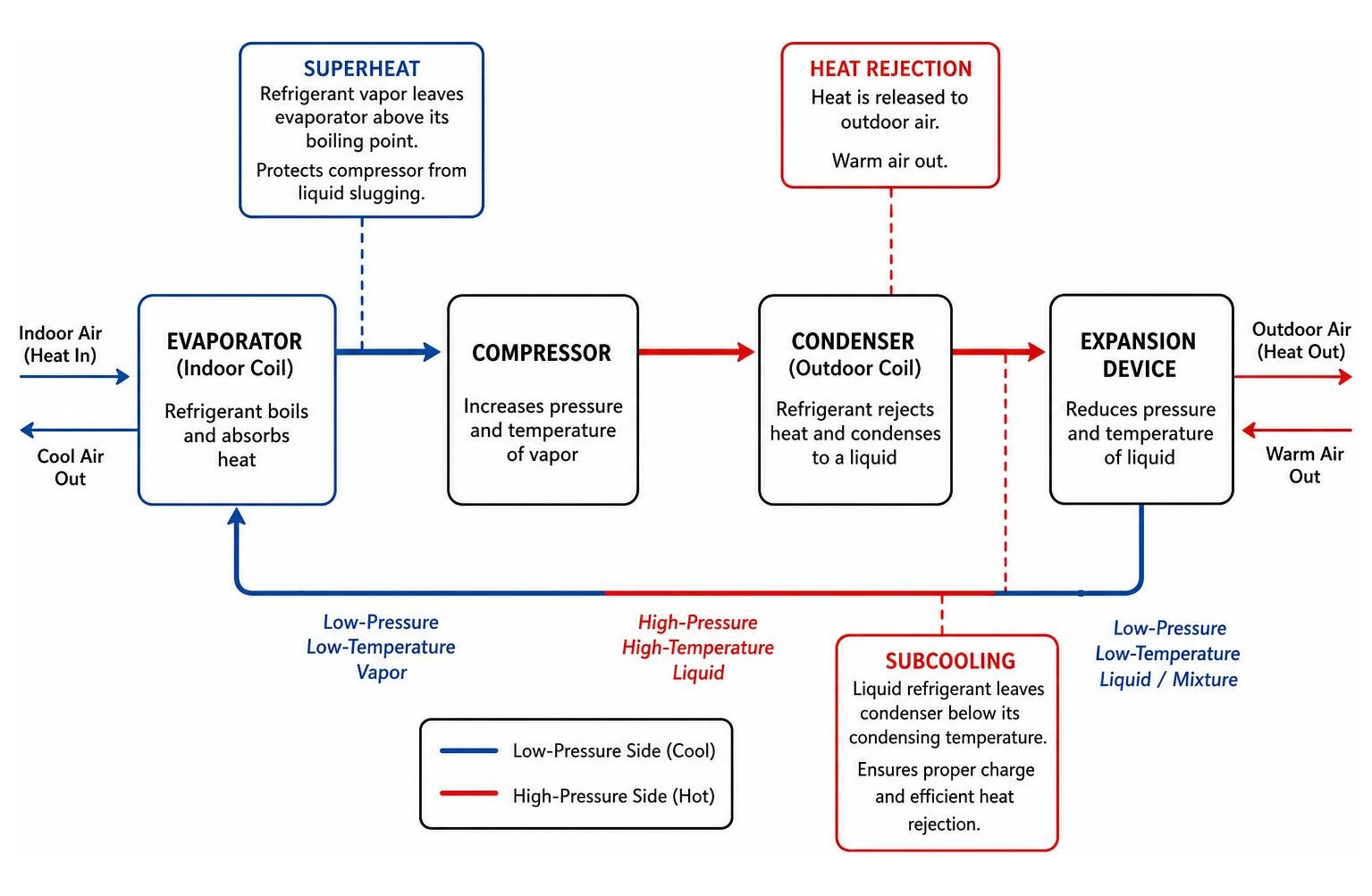
The physics of refrigeration is all about heat transfer. Your air conditioner does not actually “create” cold air; it absorbs heat from inside your home and rejects it outdoors. This process relies on precise thermodynamic properties, specifically superheat and subcooling.
- Superheat refers to the temperature of the refrigerant vapor above its boiling point as it leaves the indoor evaporator coil. Technicians measure superheat to ensure that only 100% vapor enters the compressor. If the refrigerant charge is wrong or airflow is restricted, liquid refrigerant can travel back to the compressor. This is known as liquid slugging, and because liquid cannot be compressed, it will instantly destroy the compressor’s internal pistons or scrolls.
- Subcooling is the temperature drop of the liquid refrigerant after it condenses in the outdoor unit. Measuring subcooling allows us to verify if the system has the exact charge needed to reject heat efficiently. A refrigerant charge that is even 10% low—which is always the result of a microscopic leak—forces the system to run much longer and hotter to achieve the same cooling effect.
During a professional tune-up, we measure these exact physical metrics to ensure your system is operating safely within its design limits. You can read more about why this timing is so critical in our article on 3 Reasons You Should Get AC Maintenance in the Spring.
Critical Components Most Vulnerable to High-Load Failures
When an unmaintained system is subjected to the sustained load of a heat wave, several critical components are highly vulnerable to failure:
- The Run Capacitor: This is statistically the most common component to fail in a central air conditioning system. The capacitor acts like a temporary battery, delivering a high-voltage startup surge to the compressor and fan motors. Capacitors are highly sensitive to heat. When subjected to continuous runtime on a hot day, a slightly degraded capacitor will overheat, lose its capacitance, and fail. Without a working capacitor, the compressor will hum loudly but fail to start, eventually tripping the outdoor breaker.
- The Compressor: This is the heart of your AC system and a major component to replace. If the condenser coils are dirty, the compressor has to work against incredibly high head pressure to pump refrigerant. This extra work draws higher amperage, generating extreme internal heat that degrades the compressor’s lubricating oil. Running a compressor under these conditions will eventually cause it to seize.
- The Condenser Coil: Located in the outdoor unit, this coil is responsible for releasing the heat pulled from your home. When it is coated in dirt, pollen, and cottonwood seeds, it acts like an insulating blanket. The refrigerant cannot release its heat, which spikes system pressures and temperatures.
- The Evaporator Coil: Located inside your home, this coil absorbs heat and humidity from your indoor air. If airflow is restricted by a dirty air filter, the temperature of this coil will drop below freezing. The condensation on the coil will turn to ice, completely blocking airflow and eventually sending liquid refrigerant back to the compressor.
- The Blower Motor: Responsible for pushing air through your ductwork, the blower motor must work significantly harder if your duct system has high static pressure due to clogged filters or closed vents. This extra strain leads to motor overheating and premature failure.
- The Safety Float Switch: As your AC dehumidifies your home, moisture drips into a condensate pan and flows out through a drain line. Over the winter, algae and mold can grow inside this drain. During the high-humidity days of a summer heat wave, the volume of water increases dramatically. If the drain is clogged, the water backs up, tripping the safety float switch and shutting down your entire system to prevent water damage to your home.
Why AC Tune-Ups Prevent Breakdowns During the First Heat Wave of Summer
A professional AC tune-up is not just a quick visual inspection. It is an active, hands-on preventative service designed to identify and eliminate these exact mechanical and electrical failure points before they are subjected to summer’s first true stress test.
When our licensed technicians perform a tune-up in Hamilton, Stoney Creek, or Grimsby, we follow a comprehensive process that directly addresses the root causes of summer breakdowns:
- Electrical Diagnostics: We use specialized microfarad meters to test the health of your run capacitors. If a capacitor is reading below 80% of its rated value, we can replace it proactively to avoid an emergency call. We also inspect contactor points for pitting and tighten all electrical terminals to eliminate resistance.
- Coil Cleansing: We gently wash the outdoor condenser coils to remove the winter accumulation of dirt and organic debris. This restores optimal heat rejection, lowering operating pressures and reducing the workload on your compressor.
- Refrigerant Charge Verification: We measure superheat and subcooling to confirm the refrigerant charge is exactly where the manufacturer intended. If the charge is low, we identify and repair the microscopic leak rather than simply “topping it up.”
- Condensate Drain Flushing: We clear and flush the condensate drain line, removing any algae or debris buildup to ensure water flows freely away from your home, preventing unexpected safety switch shutdowns.
- Thermostat Calibration: We verify that your thermostat is communicating accurately with your cooling system, preventing unnecessary cycling and runtime.
By resolving these hidden issues in the spring, we build a “thermal margin” into your system, giving it the physical capacity to handle extreme heat without failing. Discover more about how this protects your home in our guide on the Benefits of Regular AC Maintenance.
The 90-Day Rule and Why Timing is Critical for Pre-Season Care
In the HVAC industry, we refer to the 90-Day Rule: approximately 80% of peak-season air conditioning failures are entirely predictable and preventable based on diagnostic data collected 60 to 90 days earlier.
Scheduling your tune-up in early spring (March, April, or early May) provides several major advantages:
- Avoid the Summer Service Rush: When the first heat wave hits, our phone lines—and those of every HVAC provider in Ontario—light up instantly. Wait times for service can jump from 24 hours to several days. Booking early ensures your system is ready before the heat arrives.
- Parts Availability: If we discover a weak capacitor, a failing fan motor, or a worn contactor during a spring tune-up, we have the time to source the exact OEM replacement part without any rush. During a heat wave, high demand can lead to temporary parts shortages across the region.
- Standard Scheduling: A spring service is a planned, low-stress visit scheduled at your exact convenience, allowing our technicians to take their time and thoroughly evaluate every component.
To learn more about why early spring is the absolute best time for this service, read our detailed breakdown on Why Early Spring is the Ideal Time for an AC Tune-Up.
Restoring Measurable Efficiency Losses in Neglected Systems
Skipping annual maintenance doesn’t just increase your risk of a breakdown; it actively reduces your system’s efficiency. According to the U.S. Department of Energy, a neglected air conditioning system loses 5% to 15% of its operating efficiency every single year.
This efficiency loss is cumulative. A system that hasn’t been serviced in three years can easily run 15% to 25% less efficiently than a well-maintained counterpart. This efficiency drop is caused by:
- Airflow Restriction: Dirty filters and dust-coated evaporator coils force the blower motor to run longer and draw more power to move the same volume of air.
- Fouled Coils: A thin layer of dust on the condenser coil acts as an insulator, raising head pressures and forcing the compressor to consume significantly more electricity.
By replacing dirty filters, cleaning both coils, and optimizing system pressures, a professional tune-up can restore that lost 5% to 15% of cooling efficiency. This means optimal cooling performance all summer long. Get your system primed for the heat by checking out our resource on how to Get Your Air Conditioner Ready for Summer.
Homeowner Maintenance vs. Professional AC Tune-Ups
While there are several vital maintenance tasks that homeowners can—and should—perform themselves, a truly reliable system requires the specialized tools and training of a licensed technician.
| Maintenance Task | Homeowner DIY | Licensed Technician | Why It Matters |
|---|---|---|---|
| Filter Replacement | Yes | Yes | Keeps airflow strong and prevents the indoor evaporator coil from freezing. |
| Outdoor Clearance | Yes | Yes | Maintaining a 2-foot clearance zone around the condenser prevents air recirculation. |
| Visual Inspections | Yes | Yes | Identifying obvious damage, nesting pests, or visible oil leaks early. |
| Electrical Testing | No | Yes | Requires a multimeter to measure capacitor microfarads and check for high resistance. |
| Refrigerant Handling | No | Yes | Legally requires specialized licensing and equipment to handle, measure, and leak-test refrigerant. |
| Coil Deep Cleaning | No | Yes | Delicate aluminum fins can be easily bent or damaged by high-pressure water or wrong chemicals. |
| Safety Switch Testing | No | Yes | Verifying that safety floats and limit switches will actively cut power in an emergency. |
Early Warning Signs Your AC is Struggling Under the Heat
Your air conditioner will often try to tell you that it is struggling before it shuts down completely. Homeowners should keep an eye out for these early warning signs:
- Weak or Warm Airflow: If the air coming from your supply registers feels weak or lukewarm, your system is struggling to transfer heat. This could point to a clogged filter, a failing blower motor, or a refrigerant leak.
- Frequent Cycling (Short-Cycling): If your AC turns on and off rapidly every few minutes without cooling the home, it may be overheating, experiencing electrical issues, or suffering from a failing capacitor.
- Unusual Noises: Squealing, grinding, rattling, or buzzing sounds are never normal. A buzzing sound near the outdoor unit often indicates a failing contactor or capacitor, while grinding suggests motor bearing wear.
- High Indoor Humidity: If your home feels sticky or humid despite the temperature setting, your system is not running long enough or efficiently enough to remove latent moisture.
Protecting Your Manufacturer Warranty and System Lifespan
An air conditioner is a significant investment for any home. A well-maintained system can easily last 15 to 20 years, while a neglected system often fails permanently in just 7 to 10 years.
Furthermore, almost all major HVAC manufacturers explicitly state in their warranty terms that parts coverage is only valid if the system receives documented annual professional maintenance. If a critical component like your compressor fails during a heat wave, the manufacturer may request service records from the past few years. If you cannot provide proof of professional tune-ups, your warranty claim could be denied, leaving you to cover the replacement yourself.
Keep your system protected by reading our Essential Spring AC Maintenance Tips.
Regional Climate Challenges: Managing Hamilton’s Summer Humidity
Southern Ontario has a unique humid continental climate. Because of our close proximity to Lake Ontario, Lake Erie, and the rest of the Great Lakes, our summers are characterized by intense, heavy humidity.
When we evaluate cooling needs in places like Ancaster, St. Catharines, or Niagara-on-the-Lake, we have to look at two distinct types of heat:
- Sensible Heat: This is the actual temperature you see on your thermostat.
- Latent Heat: This is the moisture (humidity) suspended in the air.
On a humid 30°C day in Hamilton, your air conditioner must work twice as hard because it has to remove the latent heat before it can effectively lower the sensible temperature. As warm, moist indoor air passes over the cold evaporator coil, the moisture condenses into liquid water, dripping into the condensate pan.
How Humidity Impacts the Need for Why AC Tune-Ups Prevent Breakdowns During the First Heat Wave of Summer
High humidity levels place an immense physical workload on your air conditioner’s drainage and filtration systems. If your indoor coil is slightly dusty, that dust combines with the heavy condensation to create a muddy residue. This residue restricts airflow, insulates the coil, and can cause the evaporator to freeze into a solid block of ice, even on a hot summer afternoon.
Furthermore, the sheer volume of water draining from your system during a humid stretch means that any minor biofilm, algae, or dust accumulation in your condensate drain line will quickly lead to a backup. A professional spring tune-up ensures that your drainage system is clear and treated to handle the heavy latent heat loads of a Southern Ontario summer.
Frequently Asked Questions About Preventing Summer AC Breakdowns
Why do air conditioners fail during extreme heat waves?
Air conditioners fail during extreme heat waves because they are forced to run continuously for hours without a break. This sustained runtime overheats weak electrical components like run capacitors, spikes system operating pressures on dirty coils, and causes systems with low refrigerant or restricted airflow to freeze up or shut down entirely.
What temperature should I set my thermostat to during a heat wave?
During a severe heat wave, the U.S. Department of Energy recommends setting your thermostat to 78°F (25°C) when you are home. Most residential air conditioners are designed to handle a maximum temperature differential of about 20°F (11°C) between the outdoor air and indoor air. Asking your system to maintain 68°F (20°C) when it is 95°F (35°C) outside forces it to run constantly without stopping, which can trigger a mechanical failure.
Can skipping annual maintenance void my manufacturer warranty?
Yes. Almost all major HVAC manufacturers require documented proof of annual professional maintenance to keep your parts warranty valid. Skipping these annual services can leave you responsible for replacing components like compressors or coils if they fail.
Conclusion
When the first major heat wave of the summer rolls across Southern Ontario, you want to be completely confident that your air conditioner is ready for the challenge.
At B & G Heating Air Conditioning & Ventilation, we are proud to be the trusted, family-owned HVAC experts serving Hamilton, Burlington, Oakville, Stoney Creek, and the surrounding communities. Our comprehensive, professional AC tune-ups are designed to give your system the strength, efficiency, and reliability it needs to keep your family cool and comfortable all summer long.
Don’t wait for the summer rush or an unexpected breakdown on the hottest day of the year. Take control of your home comfort today. Schedule your professional AC tune-up today and enjoy true peace of mind this season!