
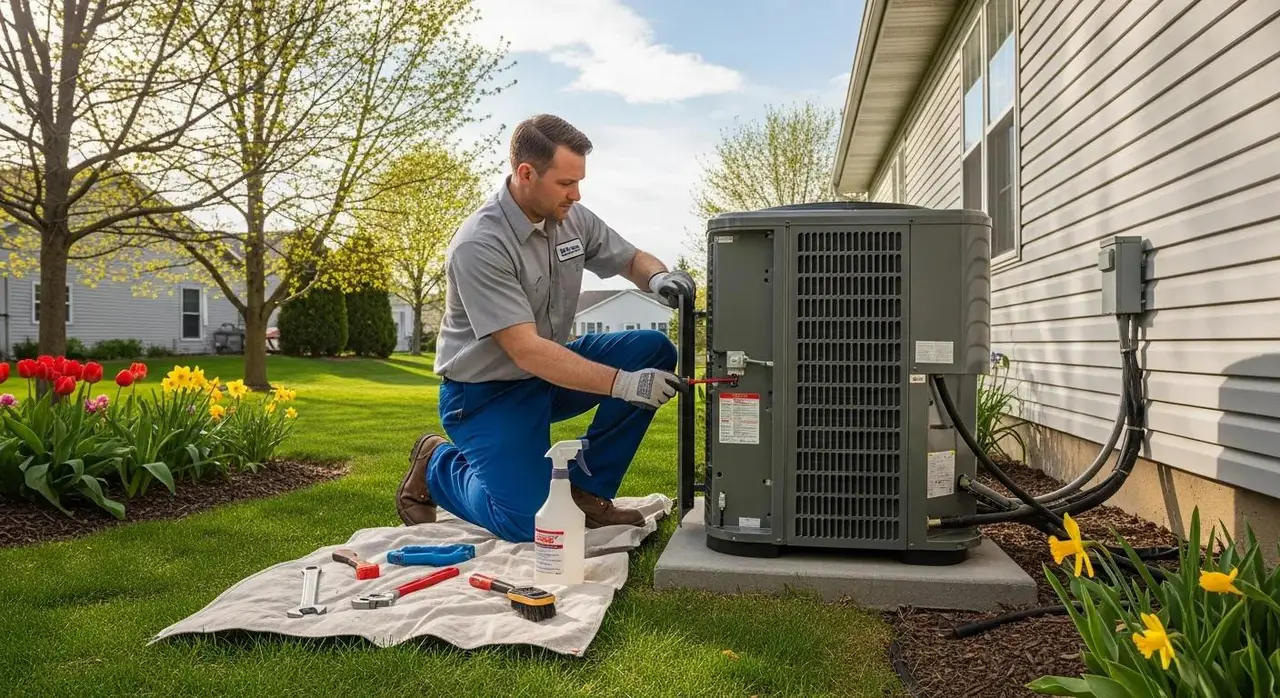
Every June, the first stretch of 30-degree humidity turns on every air conditioner in Hamilton at once — and the ones that sat neglected all winter are the ones that fail that week. Twenty minutes in April or May prevents most of those calls. Here's the homeowner-safe checklist we recommend.
Outside at the condenser
- Kill the power first. There's a disconnect box on the wall near the unit — pull it or switch it off.
- Clear two feet all around. Leaves, cottonwood fluff, the winter's blown-in debris, last year's hosta growth. The unit needs to breathe.
- Rinse the fins gently with a garden hose. Spray from the top down at modest pressure. No pressure washer — it folds the fins like foil.
- Look for damage. Bent fin patches, wires chewed by squirrels, a unit heaved off level by frost. Note anything odd.
- Check the pad. Frost heave tilts pads over the years; a badly tilted unit strains refrigerant lines and drains oil away from where the compressor needs it.
Inside
- Fresh filter. The single highest-value maintenance act in HVAC. If you can't remember buying the current one, replace it.
- Open every supply vent. Closing vents doesn't save energy with a central system — it just raises duct pressure and can freeze the coil.
- Find the condensate drain (the small pipe near the indoor unit). If you can see standing water or crust at its mouth, it wants clearing before July.
- Thermostat to "cool," fan to "auto." Set it a few degrees below room temperature.
- Restore power and listen. The compressor should hum steadily; within 10–15 minutes, supply air should be noticeably cold — around 15–20 degrees colder than the return air feels.
Grinding, repeated clicking, a breaker trip, or air that never gets cold? Shut it off and call — running a struggling AC turns affordable fixes into expensive ones.
What a professional tune-up adds
Your twenty minutes covers airflow and cleanliness. A licensed technician measures what you can't: refrigerant charge and superheat, capacitor health (the part that fails most in heat waves — measurably weak before it dies), electrical connections, blower amp draw, coil condition, and drain flow under load. That's the difference between "it turned on" and "it'll hold up in August."
Our maintenance plan members get this booked automatically each spring — reliable, scheduled, forgotten about in the best way. Either way, do the twenty minutes. Your future mid-heat-wave self says thanks.